
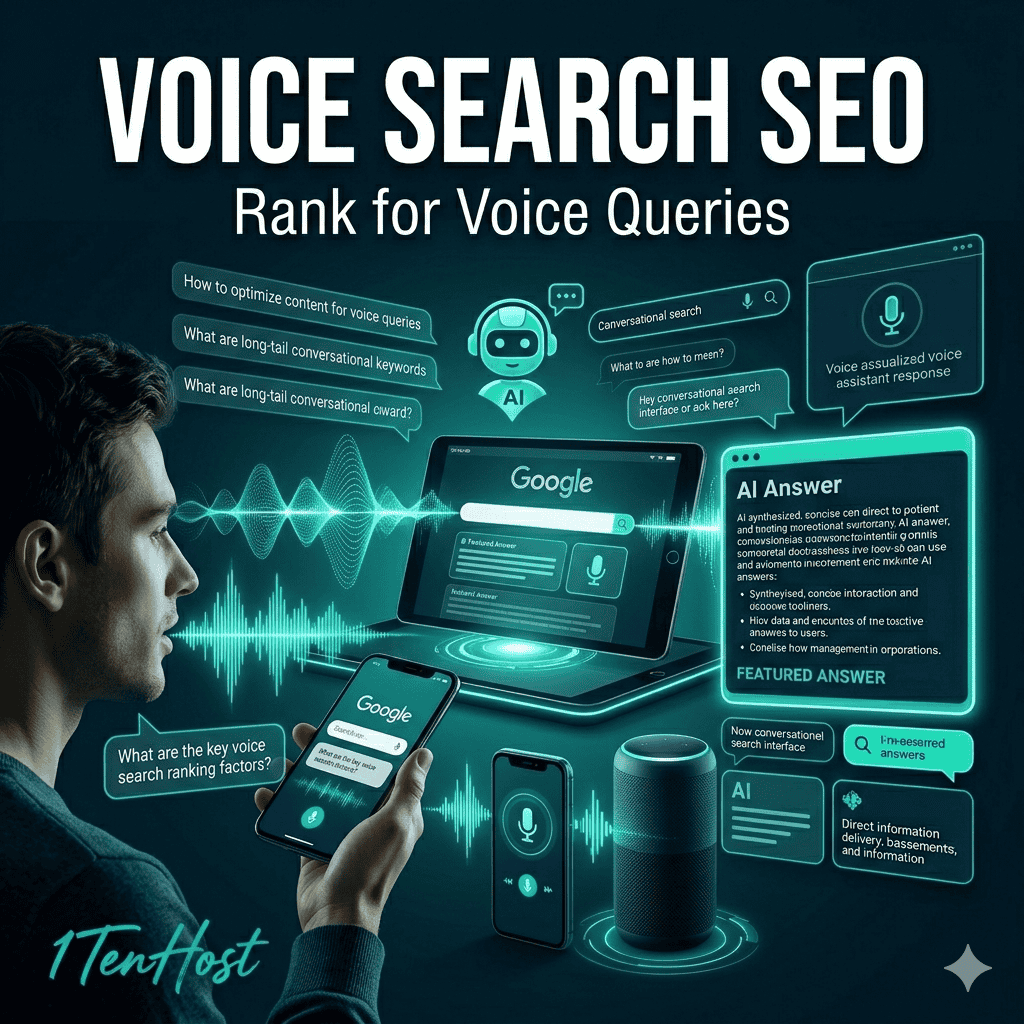
Learn how voice search optimisation in 2026 can improve rankings for Siri, Alexa, Google Assistant, and AI voice searches using conversational SEO strategies.
Introduction
Typing isn’t the only way people search anymore.
From smartphones and smart speakers to in-car assistants and AI-powered devices, voice search has become a normal part of everyday life. Users now ask questions naturally, expecting immediate and accurate answers. Whether they’re asking Siri for the nearest restaurant, requesting Alexa to find a local service, or using Google Assistant to solve a problem, voice-driven search behaviour continues to influence how content is discovered online.
As search technology evolves, businesses must adapt their SEO strategies to match how people actually speak. Traditional keyword targeting remains important, but voice search introduces new challenges and opportunities. Queries tend to be longer, more conversational, and often have stronger intent.
For businesses targeting customers in New York, London, Europe, and global markets, understanding voice search optimisation 2026 is no longer optional. It’s becoming a critical part of future-ready SEO.
In this guide, you’ll learn how voice search works, how voice queries differ from typed searches, and what steps you can take to improve your chances of appearing in voice-generated answers.
Voice Search in 2026
Voice search has matured significantly over the past few years.
Modern AI assistants are now better at understanding:
- Context
- Natural language
- Follow-up questions
- User intent
- Location-based requests
As a result, voice interactions feel increasingly conversational.
Popular Voice Search Platforms
The most widely used voice assistants include:
- Siri
- Alexa
- Google Assistant
- Samsung Bixby
- AI-powered mobile assistants
These systems help users find information without needing to type a single word.
Why Voice Search Matters
Voice searches often indicate strong intent.
Examples include:
- “Where’s the best coffee shop near me?”
- “What time does the pharmacy close?”
- “How do I optimise my website for SEO?”
Users asking these questions frequently want immediate answers or actions.
The Connection Between AI and Voice Search
Voice search is increasingly powered by artificial intelligence.
Modern AI systems can:
- Interpret conversational language
- Understand user context
- Generate direct answers
- Recommend businesses and services
This makes voice search optimisation closely connected to AEO and GEO strategies.
How Voice Queries Differ
Voice searches are fundamentally different from traditional typed searches.
Understanding these differences is essential for successful optimisation.
Conversational Query Patterns
When typing, users often enter short phrases such as:
- SEO agency London
- Pizza New York
- Best CRM software
When speaking, they tend to ask complete questions:
- Which SEO agency in London has the best reviews?
- Where can I find the best pizza in New York?
- What is the best CRM software for small businesses?
Voice searches sound more like conversations.
Why This Matters for SEO
Search engines increasingly focus on intent rather than exact keyword matching.
Content that mirrors natural speech often performs better for voice-driven searches.
Long-Tail Voice Keywords
Voice queries are generally longer.
Examples include:
- How can I improve my website rankings in 2026?
- What is the best local SEO strategy for a small business?
- Which web design agency in London offers SEO services?
Long-tail voice keywords often have:
- Lower competition
- Higher conversion potential
- Stronger search intent
Question-Based Searches
Many voice searches begin with:
- Who
- What
- When
- Where
- Why
- How
Optimising content around these question formats can improve voice visibility.
Optimising for Voice
Voice search SEO requires a slightly different content strategy than traditional optimisation.
Natural Language Content
One of the most important factors is writing naturally.
Content should:
- Sound conversational
- Answer questions directly
- Avoid unnecessary jargon
- Use clear language
Think about how real people speak when asking questions.
Structure Content Around Questions
Helpful formats include:
- FAQs
- Q&A sections
- How-to guides
- Step-by-step tutorials
These structures align closely with voice search behaviour.
Short and Direct Answers
Voice assistants often prefer concise answers.
The most successful responses are typically:
- Clear
- Accurate
- Easy to understand
Providing direct answers early in a section can increase visibility.
FAQ Pages for Voice
Dedicated FAQ sections are particularly valuable.
Examples include:
What is voice search optimisation?
Voice search optimisation is the process of improving content so it can be discovered and delivered through voice-enabled search platforms.
Why is voice search important?
Voice search helps users find information quickly through natural language conversations.
FAQ-style formatting helps search engines identify answer-ready content.
Featured Snippets and Voice Search
Many voice assistants rely on featured snippets.
Optimising for:
- Position zero
- Direct answers
- Structured content
can improve your chances of being selected.
Local Voice Search
Local searches represent one of the fastest-growing areas of voice search.
Many users rely on voice assistants when searching for nearby businesses.
“Near Me” Voice Queries
Examples include:
- Restaurants near me
- SEO agency near me
- Coffee shop open now
- Best plumber near me
These searches often indicate immediate purchase intent.
Local SEO and Voice Search
To improve local voice visibility:
- Optimise your Google Business Profile
- Maintain consistent NAP information
- Build local citations
- Encourage customer reviews
- Create local landing pages
These factors help search engines understand location relevance.
Hyperlocal Optimisation
Businesses targeting areas such as:
- Manhattan
- Brooklyn
- Soho London
- Canary Wharf
- Westminster
can create content specifically addressing local search intent.
Mobile Search Importance
Most voice searches occur on mobile devices.
Ensure your website provides:
- Fast loading speeds
- Mobile responsiveness
- Easy navigation
- Clear contact information
User experience remains a major ranking factor.
Voice Schema Markup
Structured data helps search engines understand content more effectively.
Schema markup can improve eligibility for voice search responses.
SpeakableSpecification Schema
Speakable schema identifies content suitable for text-to-speech systems.
It helps search engines recognise sections that can be read aloud by voice assistants.
Additional Schema Types
Useful schema types include:
- FAQ Schema
- Local Business Schema
- Organisation Schema
- Article Schema
- Product Schema
Structured data enhances content understanding.
Benefits of Schema Markup
Proper schema implementation can help:
- Improve content visibility
- Increase rich result opportunities
- Support voice assistant interpretation
- Enhance AI search compatibility
Combining Schema with Quality Content
Schema alone won’t guarantee rankings.
Success still depends on:
- Helpful content
- Authority
- Technical SEO
- User experience
Schema works best when supporting strong content foundations.
Measuring Voice Traffic
Tracking voice search performance can be challenging because most analytics platforms don’t explicitly separate voice traffic.
However, several indicators can provide useful insights.
Monitoring Long-Tail Queries
Review search console data for:
- Question-based searches
- Conversational phrases
- Natural language queries
Growth in these areas often suggests improved voice visibility.
Featured Snippet Tracking
Since many voice assistants use featured snippets, monitor:
- Position zero rankings
- FAQ performance
- Rich result visibility
These metrics often correlate with voice search success.
Local Search Metrics
For local businesses, monitor:
- Phone calls
- Direction requests
- Google Business Profile interactions
- Mobile conversions
Voice search frequently influences these actions.
Measuring User Intent
Focus on outcomes such as:
- Leads generated
- Calls received
- Form submissions
- Sales conversions
Ultimately, business results matter more than traffic alone.
Best Practices for Voice Search Optimisation in 2026
To improve your voice search visibility, focus on:
- Natural language content
- Conversational keywords
- Long-tail search phrases
- Question-based headings
- FAQ sections
- Structured data implementation
- Local SEO optimisation
- Mobile-first experiences
- Featured snippet targeting
These strategies help align content with modern search behaviour.
FAQs
What is voice search optimisation?
Voice search optimisation is the process of improving website content so it can be discovered and delivered through voice assistants such as Siri, Alexa, and Google Assistant.
Does voice search still matter in 2026?
Yes. Voice search continues to grow as users increasingly interact with AI-powered assistants across mobile devices, smart speakers, and connected technology.
How do voice search keywords differ from traditional keywords?
Voice search keywords are typically longer, more conversational, and often phrased as complete questions.
Can voice search improve local SEO?
Absolutely. Many voice searches involve local intent, making voice optimisation particularly valuable for local businesses.
Does schema markup help voice search rankings?
Schema markup helps search engines better understand content and can improve eligibility for voice-related search features and rich results.
Conclusion
Voice search optimisation in 2026 is about understanding how people naturally communicate with technology. As AI assistants become more sophisticated, search behaviour continues shifting towards conversational interactions and direct answers.
Businesses that adapt their content to match natural language patterns, optimise for long-tail questions, implement structured data, and strengthen local SEO signals will be better positioned to capture voice-driven traffic.
While voice search may not replace traditional search, it’s becoming an increasingly important component of a modern SEO strategy. Brands that prepare now will be more visible across the growing ecosystem of AI-powered search experiences.
Contact Information
Looking to improve your SEO, voice search visibility, AEO, or AI search performance?
Website: 1tenhost.com
Email: info@1tenhost.com
WhatsApp: wa.me/923451151625
Call: +923453075518
Address: P.no 2, S.713 Jaffar e Tayyar Socity, 75050, Karachi, Pakistan
Map Location: https://maps.app.goo.gl/NfLfM6VkL2UxAqjbA

1TenHost.com





Leave a Reply