

Quick answer: Over 12 months, Bathroom Global grew organic search visibility to 187,000 impressions and 2,730 clicks, at an average position of 13.5 and a 1.5% average CTR. The strongest gains came from branded search trust, early traction on trend and commercial product terms, and unplanned but promising international visibility across five European languages.
When we last reported on Bathroom Global’s organic performance, we were three months into the engagement. Enough data to show early momentum, not enough to prove it was durable. Twelve months of Google Search Console data later, the picture is clearer: a bathroom retailer that started as a well-regarded local showroom in Uxbridge has built genuine topical footprint across product categories, trend content, and international demand.
This case study explains what changed, why it worked, and what any eCommerce store owner competing against bigger, better-funded retailers can take from it.
12-Month Snapshot
| Metric | 12-Month Total |
|---|---|
| Total Clicks | 2,730 |
| Total Impressions | 187,000 |
| Average CTR | 1.5% |
| Average Position | 13.5 |
Two numbers matter more than they first appear. An average position of 13.5 across 187K impressions means Bathroom Global is now visible for a genuinely wide keyword footprint, most of it just outside page one. A blended CTR of 1.5% against that impression volume tells a specific story: brand and local demand converts extremely efficiently, while broader commercial and trend terms still have significant untapped click potential. Both threads run through the rest of this report.
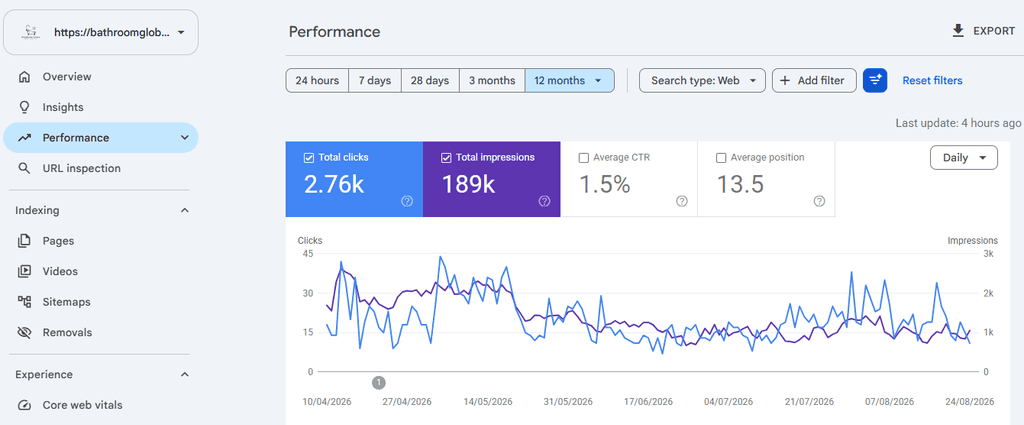
The Challenge: Competing Against Bigger Retailers
Bathroom Global isn’t competing against a handful of direct rivals. It’s competing against national home improvement chains, multi-brand plumbing aggregators, and marketplace listings that outspend a regional retailer many times over on content and links. Ranking in that environment required solving three structural problems before any keyword targeting could work:
- Thin category pages. Category and collection pages read like inventory listings rather than buying guides, with no differentiation and no reason for Google, or a shopper, to prefer them over a bigger competitor’s near-identical page.
- Weak internal link architecture. High-value product and category pages weren’t consistently linked from blog and guide content, so authority generated by newer pages had no clear path back to the commercial pages that actually drive revenue.
- Unoptimized multilingual signals. The site was already attracting international interest, since a wall-hung toilet or LED mirror looks the same in any language, but nothing in the technical or content setup was built to capture that demand deliberately.
None of these problems are unusual. What makes them worth solving deliberately is that they compound: thin pages don’t earn links, weak internal linking doesn’t distribute the links they do earn, and neither gets fixed by simply publishing more content on top.
Strategic Execution: The 1TenHost SEO Approach
eCommerce & Category SEO
Category structures were rebuilt around the way people actually search for bathroom fixtures, clustering pages by product type and use case (vanities, concealed cistern toilets, wall-hung units) rather than by internal SKU logic. Each cluster was paired with supporting content and cross-links designed to move authority from informational pages toward the transactional pages that convert.
Topical Authority & Trend Capitalization
Rather than chasing only static, evergreen product terms, content was built around forward-looking, seasonally relevant search demand, including 2026 trend and buying-guide content. This layer now accounts for a meaningful share of non-branded impressions, and it carries the clearest room to grow.
AI-Ready & NLP Optimization (AEO/GEO)
Product and guide content was structured with clear headings, direct-answer summaries, comparison tables, and structured data so it’s legible not just to classic search crawlers but to AI answer engines and generative search tools pulling in product and buying-guide context. This is a forward bet: as more commercial research happens inside AI-generated answers, being structured for extraction matters as much as being structured for ranking.
Global SERP Expansion
No dedicated multilingual content was built. The international visibility below is the result of the English-language product and trend pages being well-structured enough to surface for non-English queries with matching intent. It’s a signal of underlying content quality more than a deliberate localization play, and it points to a genuine expansion opportunity.
Data Breakdown: Branded Search Is Doing Its Job
| Query | Clicks | Impressions | CTR | Avg. Position |
|---|---|---|---|---|
bathroom global | 587 | 1,334 | 44.0% | 1.4 |
bathroom global uxbridge | 40 | 471 | 8.5% | 1.8 |
global bathrooms | 40 | 206 | 19.4% | 5.9 |
bathroom global reviews | 18 | 130 | 13.9% | 2.3 |
A 44% CTR at position 1.4 is close to what you’d expect from a healthy, trusted brand term. This is the foundation everything else is built on, and it confirms the local showroom’s reputation is translating directly into search behavior.
Where the Growth Is Coming From
Beyond branded search, three categories of demand are driving the account’s growth:
- Trend and buying-guide content, tied to forward-looking, dated topics (such as 2026 lighting and accessories trends), is ranking inside or near the top 10 within a year of focused investment, which is fast for a competitive niche.
- Core commercial product categories (concealed cistern toilets, wall-hung vanities, modern toilet designs, bathroom mirrors) are generating strong impression volume, with several terms already sitting at page-one or near-page-one positions.
- A small number of high-volume queries are earning excellent rankings, some in the top 10, but converting almost no clicks. This is the single most actionable finding in the data: visibility is there, but titles, meta descriptions, and rich-result markup aren’t yet earning the click. Closing even a fraction of that gap, moving CTR from near 0% to a modest 2 to 3%, would add hundreds of monthly clicks without touching rankings at all.
Unplanned International Reach
Without dedicated localization work, Bathroom Global content is already surfacing for lighting and mirror related searches across five languages: German, French, Polish, Spanish, and Dutch.
This is demand the site is currently catching by accident. It’s strong evidence that a deliberate, even lightweight, multilingual content or hreflang strategy could turn incidental impressions into a genuine secondary growth channel.
Frequently Asked Questions
How long does it take to see SEO results for an eCommerce bathroom retailer? In this case, branded search authority was established quickly, while competitive commercial and trend terms began moving into top-10 positions within 12 months of consistent content and structural work.
What is the biggest quick-win opportunity in this data? High-ranking pages with strong impressions but very low click-through rate. Improving title tags, meta descriptions, and structured data on these pages is typically faster to execute than earning new rankings from scratch.
Does international search traffic matter for a UK-based retailer? Yes. Organic visibility across German, French, Polish, Spanish, and Dutch queries shows real cross-border demand for bathroom products, even without any deliberate localization effort, making it a low-risk area for expansion.
Key Takeaways & Next Phase Growth Plan
What this proves for eCommerce store owners:
- Brand and local SEO compound fast. A 44% CTR on branded terms didn’t happen by accident. It’s the payoff of consistent, trustworthy on-site and off-site signals, and it’s the cheapest traffic you’ll ever earn.
- Trend content is a legitimate acquisition channel, not just a content-marketing nice-to-have. Fast movement on dated, forward-looking topics shows this approach can work quickly in a niche where competitors are mostly publishing static product pages.
- Impressions without clicks are a solvable problem, not a dead end. High-ranking, low-CTR pages are worth more short-term revenue than most net-new keyword targeting would deliver.
- Unplanned international visibility is a signal worth acting on, not ignoring. If demand shows up organically, it’s usually a sign that deliberate investment there will outperform a new market entered cold.
The next phase priorities:
- CTR recovery on high-impression pages. Rewrite titles and meta descriptions on the strongest-ranking, lowest-CTR pages, and add product or review schema to compete for rich snippets.
- Push near-page-one rankings over the line. Several high-volume category terms are sitting just outside page one and have the impression volume to justify targeted link-building and content depth work.
- Formalize the multilingual opportunity. Implement hreflang and lightly localize top-performing lighting and mirror guides into the languages already generating the most incidental impressions.
- Scale the trend-content playbook. The 2026 trend content cluster is the fastest-moving part of the account. Extending it into adjacent categories, such as showers, taps, and tiles, is the clearest path to compounding next year’s numbers the way branded search compounds this year’s.
Twelve months in, Bathroom Global has moved from a solid local brand to a site with a real, if still partially unclaimed, footprint across commercial, trend, and international search. The branded numbers show the trust is there. The next phase is about converting the visibility that’s already been earned into clicks that are still sitting on the table.

1TenHost.com





Leave a Reply