
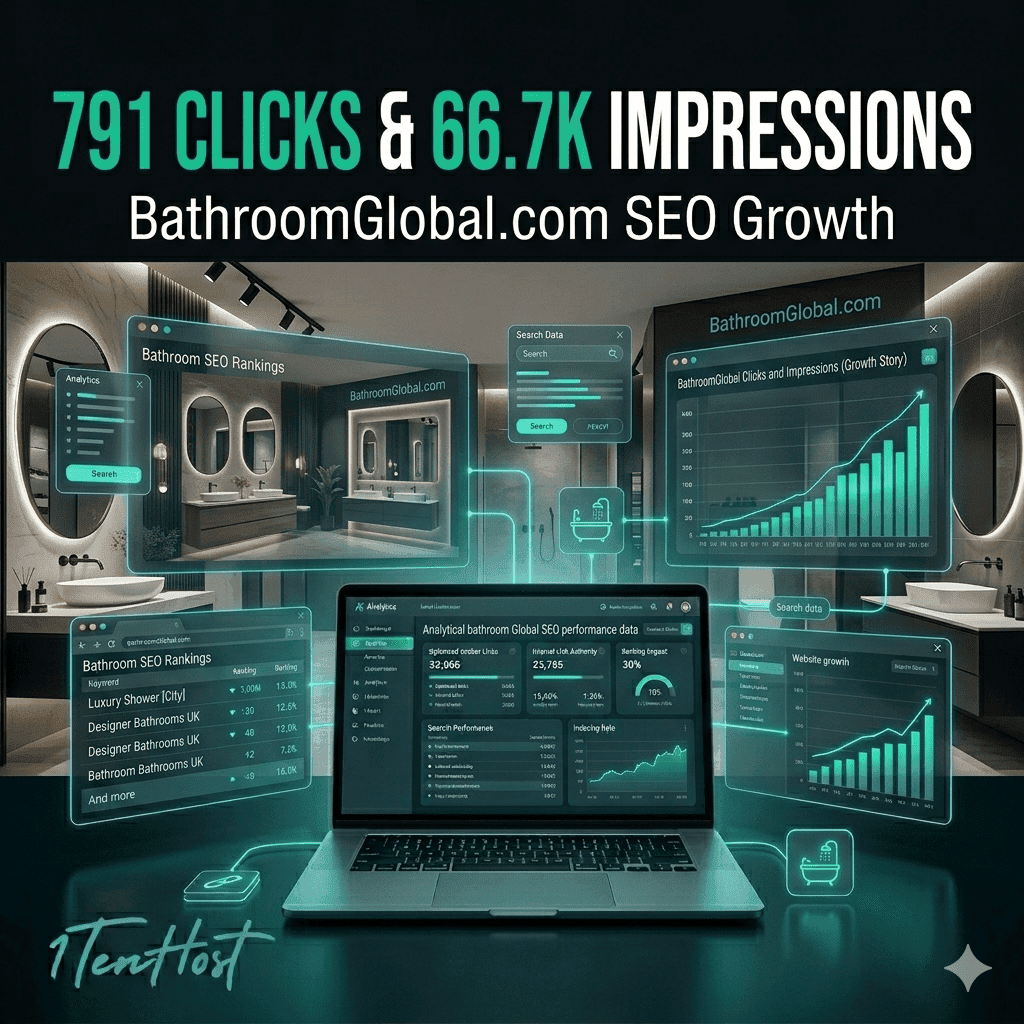
How 1TenHost helped Bathroom Global increase organic visibility to 791 clicks and 66,700 impressions through product-focused SEO, category optimisation, technical improvements, and AI-ready search architecture.

Performance Overview
3-Month Google Search Console Snapshot
- Total Clicks: 791
- Total Impressions: 66.7K
- Average CTR: 1.2%
- Average Position: 10.1
The project showed stable organic growth with improving click-through rates and stronger rankings across bathroom products, accessories, and category-based searches.
Executive Summary
The bathroom and home improvement market is highly competitive in search results. Large retailers, marketplaces, and established eCommerce brands dominate most high-volume keywords related to bathroom accessories, fittings, vanities, mirrors, showers, and renovation products.
Bathroom Global partnered with 1TenHost to improve search visibility, strengthen technical SEO, and build long-term topical authority within the bathroom and renovation niche.
The campaign focused on:
- eCommerce SEO
- category-page optimisation
- technical SEO
- structured data
- informational content
- AI-search optimisation
- internal linking architecture
Within the campaign period, the website achieved:
- 791 organic clicks
- 66,700 impressions
- 1.2% CTR
- Average ranking position of 10.1
The site also began gaining stronger visibility across transactional and informational search intent related to bathroom products and renovation searches.
The Challenge
Before the SEO campaign, the website struggled to compete against:
- Large eCommerce marketplaces
- Established bathroom brands
- National home improvement retailers
- High-authority product aggregators
Pre-Engagement Issues
| Issue | Impact | Priority |
|---|---|---|
| Weak category optimisation | Low ranking relevance | Critical |
| Thin product descriptions | Poor keyword coverage | Critical |
| Limited topical authority | Weak semantic trust | High |
| Poor internal linking | Crawl inefficiency | High |
| Missing FAQ schema | Reduced SERP visibility | Medium |
| Weak AI-search readiness | Poor NLP understanding | High |
The site also lacked strong informational content targeting renovation-related queries that help build authority and support product rankings.
Phase 1: SEO Audit & Discovery
The first stage focused on technical SEO auditing, keyword mapping, competitor analysis, and crawl optimisation.
Key Audit Findings
| Finding | Impact |
|---|---|
| Weak category hierarchy | Reduced crawl depth efficiency |
| Duplicate product patterns | Indexing dilution |
| Missing structured data | Lower rich-result visibility |
| Low semantic keyword depth | Weak topical authority |
| Thin collection pages | Low informational relevance |
| Missing FAQ sections | Lost voice-search traffic |
Competitor analysis showed that top-ranking bathroom websites were heavily investing in:
- product clusters
- category SEO
- buying guides
- renovation advice
- FAQ schema
- AI-readable content structure
Phase 2: The 1TenHost SEO Strategy
1. Category & Collection SEO
We expanded and optimised:
- category pages
- collection pages
- product hierarchy
- SEO titles
- meta descriptions
- internal linking structures
Each collection was redesigned around:
- transactional intent
- semantic keyword relevance
- AI-readable structure
- conversion-focused UX
2. Informational Topical Authority
Content clusters were built around:
- bathroom renovation
- shower systems
- vanity selection
- bathroom accessories
- bathroom layouts
- fittings & fixtures
- maintenance guides
This improved semantic authority and increased visibility for long-tail informational searches.
3. Technical SEO & Core Web Vitals
Technical improvements included:
- image optimisation
- crawl cleanup
- schema markup
- sitemap restructuring
- page-speed optimisation
- Core Web Vitals improvements
These changes improved crawl efficiency and user experience across mobile and desktop devices.
4. AI Search & NLP Optimisation
The website structure was prepared for modern AI-driven search systems through:
- semantic heading structures
- FAQ schema
- entity optimisation
- conversational search targeting
- NLP-friendly formatting
- AI-readable internal linking
This supports visibility across:
- ChatGPT
- Google Gemini
- Claude AI
- Perplexity AI
- Bing AI ecosystems
The campaign also included future-proof indexing strategies for evolving AI-search behaviour.
Organic Growth Highlights
Growth Indicators
- Organic clicks reached 791
- Impressions scaled to 66.7K
- CTR improved to 1.2%
- Average ranking position improved steadily
- Category visibility expanded
- Informational search footprint increased
SEO Improvements Achieved
The strongest growth areas included:
- category page rankings
- informational bathroom searches
- product-related long-tail queries
- semantic keyword coverage
- brand visibility growth
Results: 3-Month Performance Snapshot
| Metric | Result |
|---|---|
| Total Clicks | 791 |
| Total Impressions | 66.7K |
| Average CTR | 1.2% |
| Average Position | 10.1 |
The site demonstrated consistent upward search visibility trends with stronger engagement metrics compared to the early campaign stages.
Key Takeaways
Category SEO Drives eCommerce Growth
Well-structured category pages remain one of the strongest ranking assets for eCommerce SEO.
Informational Content Supports Product Rankings
Educational content around bathroom renovation and buying decisions helped improve overall domain authority.
AI-Ready SEO Is Becoming Essential
Modern SEO now requires optimisation for:
- NLP understanding
- conversational search
- AI indexing
- semantic entities
- AI-generated search summaries
Preparing websites for AI-driven discovery improves long-term visibility.
Technical SEO Still Matters
Page speed, crawl structure, schema markup, and internal linking significantly impacted indexing efficiency and rankings.
Conclusion
Through a combination of:
- category SEO
- topical authority
- technical optimisation
- semantic content strategy
- AI-search preparation
- structured internal linking
1TenHost helped Bathroom Global achieve measurable organic growth in a competitive home improvement niche.
The next growth phase focuses on:
- expanding transactional keyword coverage
- increasing CTR
- scaling informational content
- improving rich-result visibility
- strengthening product entity authority
Forecast modelling suggests continued SEO expansion could significantly increase clicks and conversions over the next 6–12 months.
Frequently Asked Questions
How long does SEO take for an eCommerce website?
Most eCommerce websites begin seeing measurable traction within 3–6 months, while stronger category and product rankings typically require 6–12 months depending on competition.
What SEO strategy worked best for BathroomGlobal.com?
The strongest results came from:
- category-page optimisation
- technical SEO
- topical authority content
- FAQ schema
- semantic internal linking
- AI-search optimisation
Why are impressions higher than clicks?
During growth phases, Google often tests websites across many keywords before CTR fully improves. As rankings strengthen and brand trust grows, clicks generally rise faster.
Does AI-search optimisation matter for eCommerce?
Yes. AI-driven search systems increasingly rely on:
- semantic structure
- NLP clarity
- entities
- schema markup
- conversational content
Preparing for AI search helps future-proof organic visibility.

1TenHost.com





Leave a Reply