
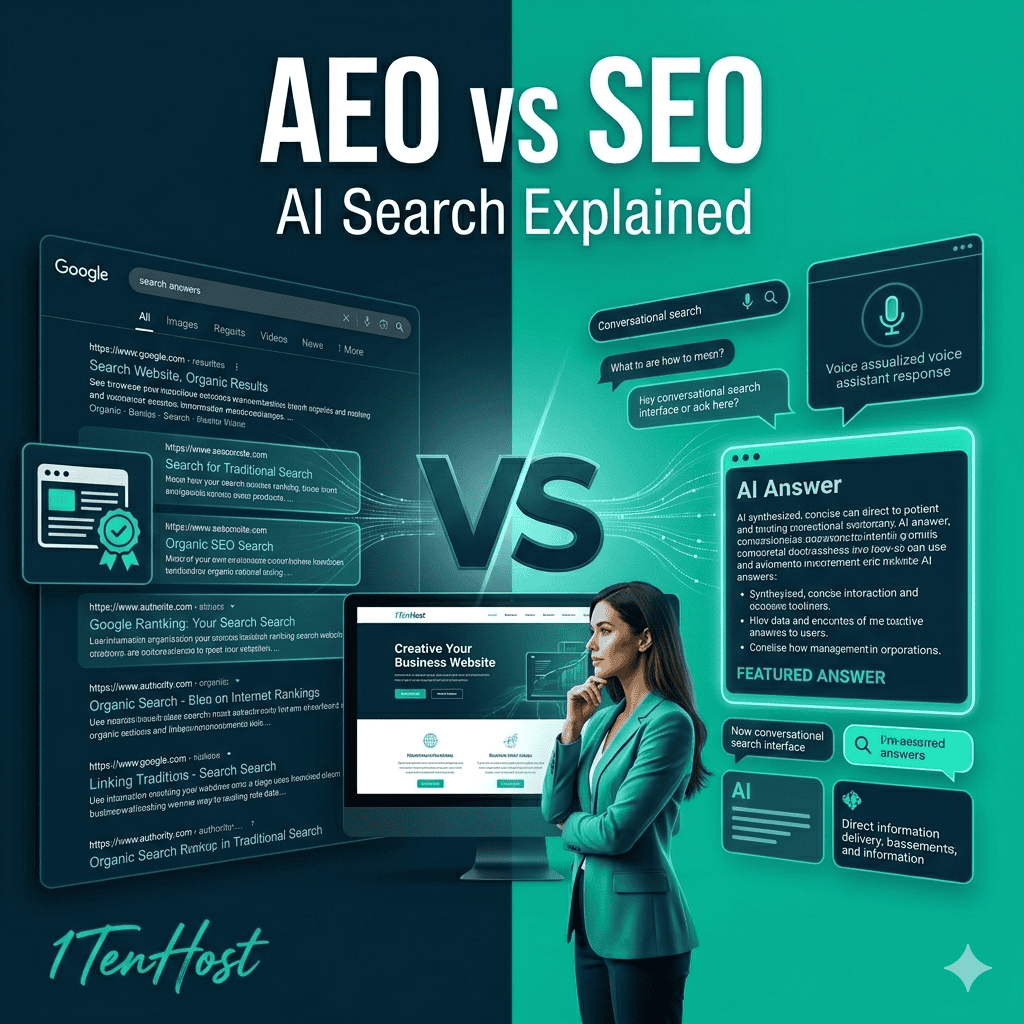
Discover the difference between AEO and SEO in 2026. Learn how answer engine optimisation, AI search, ChatGPT, Google AI Overviews, and traditional SEO work together.
Introduction
For years, businesses focused almost entirely on Search Engine Optimisation (SEO) to improve their visibility on Google and drive organic traffic. The strategy was straightforward: rank higher, attract clicks, and convert visitors into customers.
However, search behaviour is changing rapidly.
Today, users don’t always click through to websites. Instead, they often receive answers directly from search engines, AI assistants, and conversational platforms. Whether it’s Google AI Overviews, ChatGPT, Gemini, or Perplexity, modern search increasingly revolves around delivering answers rather than simply listing links.
This shift has led to the rise of Answer Engine Optimisation (AEO).
While SEO focuses on improving rankings in traditional search results, AEO focuses on helping content become the answer itself. As AI-powered search continues to evolve, businesses must understand how these two strategies differ and how they can work together.
In this guide, we’ll explore the AEO vs SEO difference, explain how each approach works, compare ranking factors, and show how businesses can build a future-ready search strategy.
How SEO Works
SEO is the process of improving a website’s visibility in traditional search engine results.
The goal is simple: rank higher for relevant keywords and attract organic traffic.
Core Components of SEO
Traditional SEO typically includes:
- Keyword research
- On-page optimisation
- Technical SEO
- Link building
- Content marketing
- Internal linking
- User experience improvements
These elements help search engines understand and rank content.
How Search Engines Evaluate Content
Search engines consider factors such as:
- Relevance
- Authority
- Content quality
- Backlinks
- Technical performance
- User engagement
Pages that perform well across these areas are more likely to rank prominently.
Benefits of SEO
SEO continues to provide:
- Long-term traffic
- Brand visibility
- Lead generation
- Sustainable growth
- High return on investment
Even in the AI era, SEO remains the foundation of digital visibility.
How AEO Works
Answer Engine Optimisation focuses on helping content become the direct answer to a user’s question.
Instead of competing solely for rankings, AEO aims to position content where search engines and AI systems can easily extract and present information.
What Is an Answer Engine?
Answer engines provide direct responses rather than lists of links.
Examples include:
- Google AI Overviews
- Voice assistants
- Featured snippets
- AI chatbots
- Conversational search tools
Users receive immediate answers without necessarily visiting a website.
AEO Optimisation Techniques
AEO strategies often include:
- Question-based content
- FAQ sections
- Structured data
- Schema markup
- Clear definitions
- Concise explanations
- Conversational content formatting
These elements make content easier for answer engines to interpret.
Why AEO Is Growing
Users increasingly search using natural language.
Examples include:
- What is answer engine optimisation?
- How does AI search work?
- What’s the difference between AEO and SEO?
Answer-focused content performs particularly well for these searches.
Key Differences
Although SEO and AEO overlap in many areas, their primary objectives differ.
Ranking Signals Comparison
SEO typically prioritises:
- Keywords
- Backlinks
- Technical SEO
- Page authority
- User experience
AEO places greater emphasis on:
- Direct answers
- Content clarity
- Structured data
- Contextual relevance
- Conversational formatting
Both require high-quality content, but the optimisation approach differs.
Content Format Differences
SEO content often focuses on:
- Comprehensive topic coverage
- Long-form articles
- Keyword targeting
- Internal linking structures
AEO content often focuses on:
- Question-and-answer formats
- FAQs
- Definitions
- Step-by-step explanations
- Short answer sections
The best-performing content often combines both approaches.
SEO vs AEO Comparison
| Factor | SEO | AEO |
|---|---|---|
| Primary Goal | Rankings | Direct Answers |
| Traffic Focus | Website Visits | Answer Visibility |
| Content Style | Comprehensive | Concise & Structured |
| Optimisation Focus | Keywords & Authority | Questions & Clarity |
| Search Environment | Traditional Search | AI & Answer Engines |
| Long-Term Importance | Very High | Increasing Rapidly |
Do You Need Both?
The short answer is yes.
SEO and AEO are not competing strategies. They are complementary.
When to Prioritise SEO
SEO should remain the primary focus when:
- Building organic traffic
- Growing domain authority
- Targeting competitive keywords
- Expanding content visibility
Without SEO foundations, AEO opportunities become more limited.
When to Prioritise AEO
AEO becomes particularly valuable when:
- Targeting informational searches
- Competing for featured snippets
- Improving voice search visibility
- Increasing AI search exposure
Businesses that publish educational content often benefit significantly from AEO.
Why Combining Both Works Best
Modern search experiences often blend traditional rankings with answer generation.
Businesses that optimise for both gain:
- More visibility
- Greater authority
- Increased traffic opportunities
- Better AI search performance
The future belongs to integrated strategies.
AI Search Landscape
The rise of AI-powered search has fundamentally changed how information is discovered online.
Perplexity, ChatGPT, Gemini
AI platforms now answer millions of questions daily.
Popular examples include:
- ChatGPT
- Perplexity
- Gemini
- Claude
- Google AI Overviews
These systems synthesise information from multiple sources to generate responses.
How ChatGPT Ranks Content
Unlike traditional search engines, AI systems don’t rely exclusively on keyword rankings.
They evaluate factors such as:
- Content quality
- Authority signals
- Topical relevance
- Source credibility
- Contextual relationships
This makes expertise and trust increasingly important.
The Impact of Google AI Overviews
Google’s Search Generative Experience (SGE) and AI Overviews provide users with summarised answers directly within search results.
This creates new opportunities for businesses that:
- Demonstrate expertise
- Structure content clearly
- Cover topics comprehensively
What AI Search Means for SEO
SEO is evolving rather than disappearing.
Success increasingly depends on:
- Topical authority
- Semantic relevance
- Entity optimisation
- EEAT signals
- Structured content
These factors support both traditional search and AI discovery.
Integrated Strategy
The most effective digital marketing strategies now combine SEO and AEO into a unified framework.
Unified Search Strategy
An integrated approach should include:
SEO Foundations
Focus on:
- Technical SEO
- Keyword targeting
- Link acquisition
- Content hubs
AEO Enhancements
Focus on:
- FAQ sections
- Structured data
- Featured snippet targeting
- Conversational answers
AI Search Readiness
Focus on:
- Topical authority
- EEAT
- Entity optimisation
- Comprehensive content coverage
Content Framework for 2026
Successful content should:
- Answer user questions clearly
- Cover topics thoroughly
- Include structured formatting
- Demonstrate expertise
- Support AI extraction
This approach improves visibility across multiple search environments.
Future-Proofing Your Strategy
As search continues evolving, businesses should prepare for:
- More AI-generated answers
- Conversational search growth
- Increased zero-click searches
- Greater emphasis on authority and trust
Adapting early creates a significant competitive advantage.
FAQs
What is the difference between AEO and SEO?
SEO focuses on improving rankings in search engines, while AEO focuses on helping content become direct answers within AI systems and answer engines.
Is AEO replacing SEO?
No. AEO complements SEO rather than replacing it. Both strategies work together to improve search visibility.
How does ChatGPT find information?
ChatGPT and other AI systems evaluate content based on relevance, authority, context, and credibility rather than relying solely on traditional ranking factors.
What is Google AI Overview optimisation?
It involves structuring content so it can be easily understood, referenced, and cited by Google’s AI-generated search summaries.
Should small businesses invest in AEO?
Yes. Businesses that publish helpful content can benefit from increased visibility in featured snippets, AI search platforms, and conversational search results.
Conclusion
Understanding the AEO vs SEO difference is essential for businesses navigating today’s search landscape. Traditional SEO remains critical for rankings and traffic generation, while AEO helps content become visible within answer engines and AI-powered search experiences.
Rather than choosing one over the other, forward-thinking businesses are combining both strategies to maximise visibility across Google, AI Overviews, ChatGPT, Perplexity, Gemini, and future search platforms.
The brands that succeed in the coming years will be those that create authoritative, well-structured content designed for both search engines and answer engines alike.
Contact Information
Looking to improve your SEO, AEO, GEO, or AI search visibility?
Website: 1tenhost.com
Email: info@1tenhost.com
WhatsApp: wa.me/923451151625
Call: +923453075518
Address: P.no 2, S.713 Jaffar e Tayyar Socity, 75050, Karachi, Pakistan
Map Location: https://maps.app.goo.gl/NfLfM6VkL2UxAqjbA

1TenHost.com




Leave a Reply