
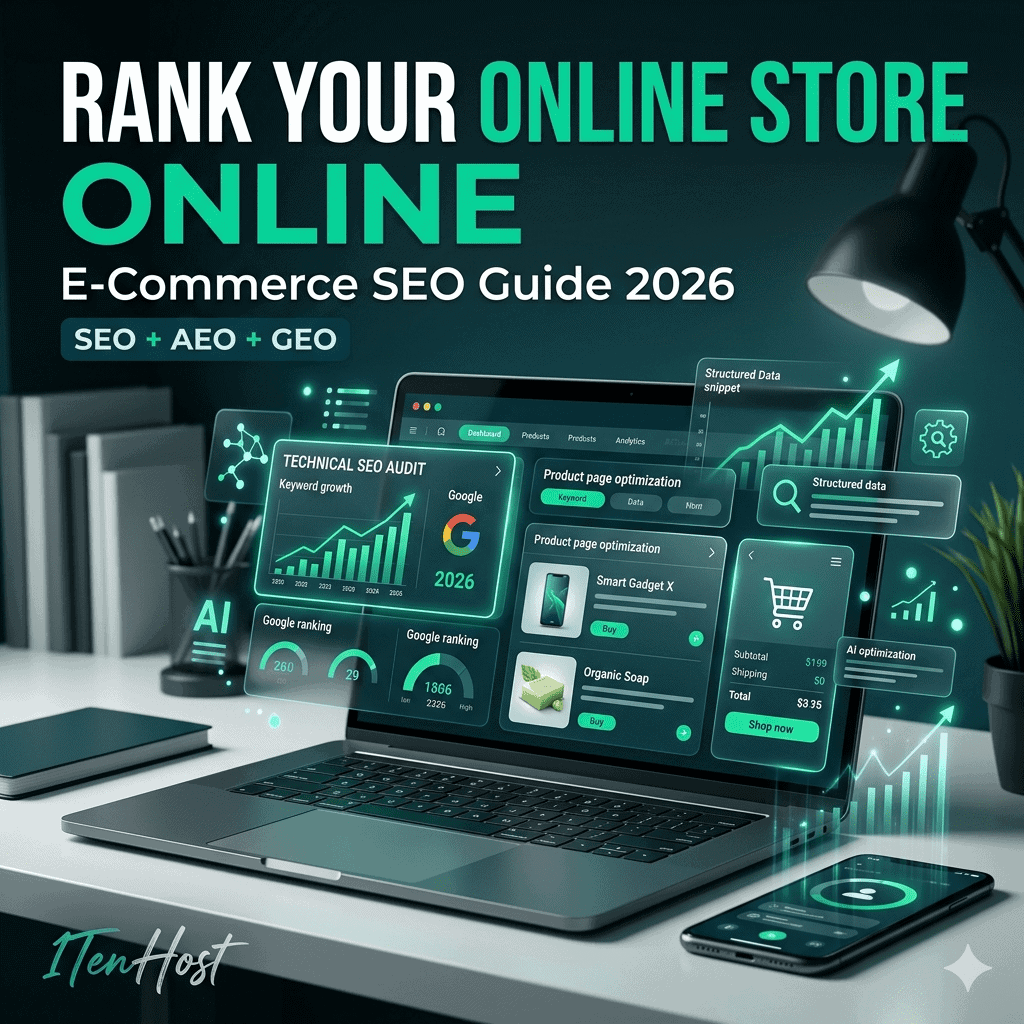
Learn the latest ecommerce SEO strategies for 2026, from product page optimisation to technical SEO, and grow your online store traffic organically.
Introduction
Running an online store in 2026 is more competitive than ever. Thousands of eCommerce websites launch every single day, yet only a small percentage actually rank on Google’s first page. Why? Because great products alone aren’t enough anymore.
Search engines now expect fast websites, structured product data, helpful content, strong user experience, and clear topical authority. Whether you run a Shopify store in London, a WooCommerce shop in New York, or an international eCommerce brand selling globally, SEO can make or break your online growth.
The good news is that eCommerce SEO isn’t about tricks or shortcuts. It’s about building a search-friendly store that helps customers find exactly what they need.
In this ecommerce SEO guide 2026, you’ll learn how to optimise product pages, improve category structures, fix technical SEO problems, target buyer-intent keywords, and build authority that actually helps your store rank higher on Google.
Why E-Commerce SEO Is Different
SEO for online stores works differently from normal business websites or blogs. An eCommerce site usually contains:
- Hundreds or thousands of product pages
- Multiple category pages
- Dynamic filters and faceted navigation
- Frequent stock updates
- Duplicate content risks
- Complex internal linking structures
That means Google has far more URLs to crawl and evaluate.
Unlike a local business website, an online store also needs to rank for commercial searches such as:
- “Buy running shoes online”
- “Best gaming laptop under £1000”
- “Affordable office chair in New York”
These searches have strong buying intent, which makes them highly competitive.
Modern shopping SEO also depends heavily on:
- Product schema markup
- Core Web Vitals
- Mobile performance
- Trust signals
- Reviews
- User experience
- AI-generated search summaries
If your site is slow, confusing, or poorly organised, rankings usually suffer.
Why SEO Matters More Than Paid Ads
Paid advertising costs continue rising across Google Shopping, Meta Ads, and TikTok Ads. Many eCommerce brands in London, Manchester, Brooklyn, and Manhattan are shifting back toward organic SEO because long-term traffic becomes more sustainable.
SEO helps you:
- Reduce customer acquisition costs
- Build long-term visibility
- Increase product discovery
- Improve conversion quality
- Create evergreen traffic sources
Keyword Research for Products
Keyword research is the foundation of successful eCommerce SEO. Without the right search terms, even beautifully designed stores struggle to attract traffic.
Buyer Intent Keywords
Buyer-intent keywords are searches people use when they’re ready to purchase.
Examples include:
- Buy wireless earbuds online
- Best standing desk UK
- Gaming mouse free delivery
- Leather handbags New York
These keywords convert better because users already know what they want.
Focus on:
- Purchase-driven phrases
- Product-specific searches
- Comparison terms
- “Best” queries
- “Affordable” searches
- Near me modifiers
- Mobile-friendly queries
For example, if your store targets London customers, phrases like:
- “same-day delivery London”
- “online trainers shop near Camden”
- “best electronics store Shoreditch”
can bring highly targeted traffic.
Naturally referencing well-known areas like Camden, Soho, Canary Wharf, Notting Hill, and Shoreditch can also strengthen local relevance.
In New York, areas like Manhattan, Brooklyn, Queens, SoHo, and Williamsburg help support hyperlocal SEO targeting.
Long-Tail Product Queries
Long-tail keywords are incredibly valuable for online stores because competition is lower and intent is stronger.
Examples:
- waterproof hiking boots for winter trekking
- ergonomic office chair for back pain
- slim fit black formal shirt mens
- organic skincare products for sensitive skin
These searches often lead to higher conversion rates.
Good tools for ecommerce keyword research include:
- Google Keyword Planner
- Ahrefs
- SEMrush
- Google Search Console
- AlsoAsked
- AnswerThePublic
You should also analyse:
- Product reviews
- Reddit discussions
- Customer support questions
- Competitor category pages
- Google autocomplete suggestions
Product Page Optimisation
Product pages are among the most important pages on an eCommerce website. Poorly optimised product pages are one of the biggest reasons online stores fail to rank.
Title, Description, Schema
Your product title should include:
- Main keyword
- Product type
- Brand name
- Key feature
Example:
“Wireless Noise Cancelling Headphones With Bluetooth 5.3”
Avoid vague titles like:
“Premium Headphones”
Product Descriptions
A good product description should:
- Solve customer concerns
- Explain benefits clearly
- Include natural keywords
- Be easy to scan
- Avoid copied manufacturer text
Instead of generic descriptions, write original content that answers actual buyer questions.
Product Schema Markup
Product schema helps Google understand:
- Pricing
- Reviews
- Stock status
- Brand
- Product details
This improves your chances of earning rich snippets in search results.
Structured data can increase click-through rates significantly because users see ratings and prices directly in Google.
Image SEO for Product Pages
Many stores ignore image optimisation completely.
Best practices include:
- Compress images properly
- Use descriptive file names
- Add keyword-focused alt text
- Enable lazy loading
- Use WebP formats where possible
Fast-loading product images improve both rankings and conversions.
Category Page SEO
Category pages often rank better than individual product pages because they target broader search intent.
For example:
- “Men’s Running Shoes”
- “Gaming Laptops”
- “Modern Office Furniture”
These pages attract users earlier in the buying journey.
Category Hierarchy
Your site structure should stay clean and simple.
Good structure example:
Home → Electronics → Laptops → Gaming Laptops
Poor structures create crawling problems and confuse search engines.
A strong hierarchy improves:
- Crawlability
- User experience
- Internal linking
- Ranking signals
Optimising Category Content
Many category pages contain almost no text. That’s a missed opportunity.
Add:
- Introductory copy
- Buying guidance
- FAQs
- Product comparisons
- Internal links
This helps category pages rank for broader commercial keywords.
Internal Linking Strategy
Internal links help distribute authority throughout your store.
Link between:
- Product pages
- Blog content
- Category pages
- Buying guides
- FAQs
For example, a blog titled:
“How to Choose Running Shoes”
can internally link to:
“Men’s Running Shoes” category pages.
This creates stronger topical relevance.
Technical E-Com SEO
Technical SEO is critical for large eCommerce websites because crawling issues can quickly spiral out of control.
Faceted Navigation Fix
Faceted navigation includes filters such as:
- Colour
- Size
- Brand
- Price range
These filters often generate thousands of duplicate URLs.
Without proper management, Google wastes crawl budget on unnecessary pages.
Solutions include:
- Canonical tags
- Noindex directives
- URL parameter handling
- Robots.txt controls
Site Speed Matters More Than Ever
Ecommerce site speed directly affects:
- Rankings
- Bounce rates
- Conversion rates
- Mobile usability
Google’s Core Web Vitals remain important ranking factors in 2026.
Ways to improve performance:
- Use CDN services
- Compress JavaScript
- Optimise images
- Reduce plugin overload
- Minimise redirects
- Use better hosting infrastructure
Mobile-First Optimisation
Most shopping traffic now comes from mobile devices.
Your store must provide:
- Fast mobile loading
- Responsive design
- Easy checkout flows
- Thumb-friendly navigation
- Readable typography
Slow mobile stores lose both rankings and sales.
Duplicate Content Issues
Duplicate content commonly appears on:
- Product variants
- Pagination
- Search pages
- Session URLs
- Filter combinations
You should use:
- Canonical URLs
- Clean indexing controls
- Consistent internal linking
to avoid confusion for search engines.
Link Building for Stores
Backlinks still matter in 2026, but quality matters far more than quantity.
Google increasingly rewards trusted, relevant links rather than spammy tactics.
Affiliate & PR Links
One of the best ways to earn backlinks is through digital PR.
Examples include:
- Product launch campaigns
- Industry research
- Seasonal shopping trends
- Influencer collaborations
- Expert commentary
- Data-driven reports
Affiliate partnerships can also generate high-quality mentions from review websites and niche bloggers.
Content Marketing for eCommerce SEO
Blogging remains powerful for online stores.
Useful content ideas include:
- Buying guides
- Product comparisons
- Trend reports
- Tutorials
- Industry news
- Seasonal gift guides
Examples:
- “Best Winter Jackets for London Weather”
- “Top Gaming Accessories for Small Apartments in Manhattan”
- “How to Choose the Right Office Chair for Remote Work”
These articles naturally support internal linking and topical authority.
Local SEO for Online Stores
Even global eCommerce brands can benefit from local SEO.
If you operate warehouses, stores, or delivery hubs in places like:
- Shoreditch
- Soho
- Canary Wharf
- Manhattan
- Brooklyn
- Queens
you can optimise for regional searches and “near me” intent.
Google Business Profile optimisation also helps local visibility.
Common E-Commerce SEO Mistakes
Many online stores struggle because of avoidable SEO issues.
Common mistakes include:
- Thin product descriptions
- Duplicate manufacturer content
- Poor site architecture
- Broken internal links
- Slow mobile performance
- Weak category pages
- Missing schema markup
- Ignoring search intent
- Keyword stuffing
- Indexing unnecessary URLs
Fixing these issues can produce surprisingly fast improvements.
Future Trends in Ecommerce SEO
Search behaviour continues evolving rapidly.
Key ecommerce SEO trends for 2026 include:
- AI-generated search summaries
- Voice search optimisation
- Visual product search
- Entity-based SEO
- First-party customer data
- Conversational search queries
- Video commerce optimisation
Google increasingly focuses on understanding intent instead of exact keyword matching.
That means topical authority matters more than isolated keywords.
Stores that publish genuinely useful content tend to outperform thin affiliate-style pages.
FAQs
How long does ecommerce SEO take to work?
Most online stores begin seeing measurable SEO improvements within 3 to 6 months, depending on competition, website quality, and backlink strength.
Is Shopify good for SEO in 2026?
Yes. Shopify SEO has improved significantly. It offers strong technical foundations, mobile optimisation, and app integrations, though advanced customisation can still be limited compared to WooCommerce.
What is the best ecommerce platform for SEO?
WooCommerce, Shopify, and Magento all perform well when properly optimised. The best choice depends on your store size, technical requirements, and scalability needs.
Why are category pages important for ecommerce SEO?
Category pages target broader commercial searches and often attract more traffic than individual product pages. They also improve site structure and internal linking.
Does site speed affect ecommerce rankings?
Absolutely. Slow-loading stores increase bounce rates and reduce conversions. Google also uses page experience signals as ranking factors.
Conclusion
Ecommerce SEO in 2026 is no longer just about adding keywords to product pages. Successful online stores now combine technical SEO, content strategy, user experience, structured data, and topical authority into one complete strategy.
Whether you run a Shopify store in London, a WooCommerce website in New York, or a growing global brand, investing in proper SEO can produce long-term traffic and consistent sales growth.
Focus on creating genuinely useful product content, improving technical performance, and building trust with both users and search engines. Over time, that combination becomes incredibly difficult for competitors to beat.
Contact Information
Need help with eCommerce SEO, technical optimisation, or growing your online store traffic?
Website: 1tenhost.com
Email: info@1tenhost.com
WhatsApp: wa.me/923451151625
Call: +923453075518
Address: P.no 2, S.713 Jaffar e Tayyar Socity, 75050, Karachi, Pakistan
Map Location: https://maps.app.goo.gl/NfLfM6VkL2UxAqjbA

1TenHost.com




Leave a Reply