
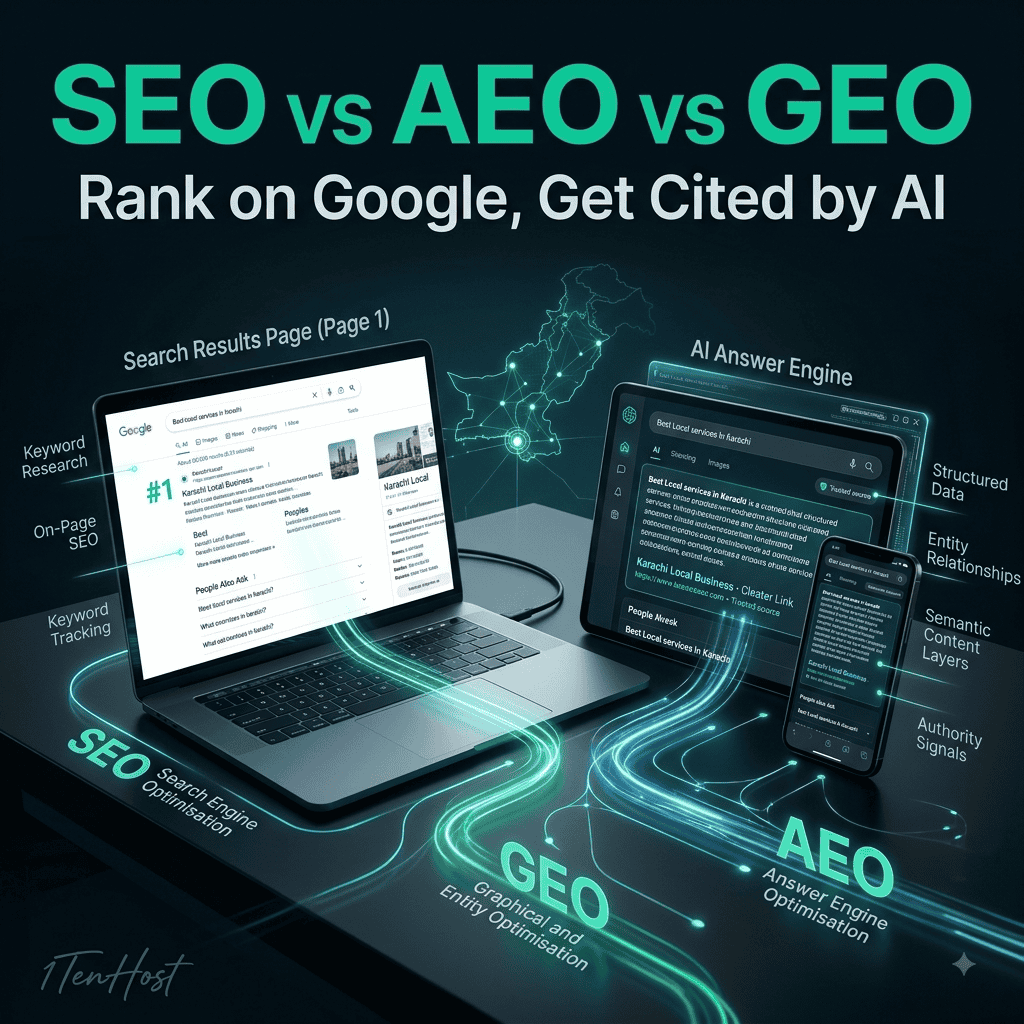
Quick answer: SEO gets your website ranked in Google’s blue links, AEO gets your content chosen as the direct answer in featured snippets and voice search, and GEO gets your brand cited or recommended inside AI-generated responses from tools like ChatGPT, Gemini and Perplexity. In 2026, none of the three works well on its own — they share the same technical and content foundation, and a page built for one is usually built for all three.
If you searched for this term, you’re probably trying to work out which of these three acronyms your business actually needs. Short answer: all three, because they’re layers of the same discipline, not competing strategies. This guide breaks down exactly how they differ, how they overlap, and the specific actions that move the needle for each one.
What Is SEO, AEO and GEO
SEO (Search Engine Optimisation) is the practice of improving a website so it ranks higher in traditional search results. It covers technical health (site speed, crawlability, mobile usability), on-page optimisation (keywords, headings, internal links) and off-page authority (backlinks, brand mentions).
AEO (Answer Engine Optimisation) is the practice of structuring content so search engines and voice assistants can lift a short, accurate answer straight out of your page and display it as a featured snippet, a “People Also Ask” result, or a spoken voice-search reply. AEO is about answerability, not just visibility.
GEO (Generative Engine Optimisation) is the practice of shaping your content and brand signals so that generative AI systems — Google AI Overviews, ChatGPT, Gemini, Perplexity and Claude — choose to cite, quote or recommend you when they synthesise an answer for a user. GEO is the newest of the three and the one growing fastest.
SEO vs AEO vs GEO at a Glance
| SEO | AEO | GEO | |
|---|---|---|---|
| Primary goal | Rank in organic search results | Get selected as the direct answer | Get cited or recommended by AI models |
| Output format | Ranked list of links | Featured snippet, PAA box, voice answer | Synthesised paragraph with citations |
| Platforms | Google, Bing organic search | Google featured snippets, Siri, Alexa | ChatGPT, Gemini, Perplexity, AI Overviews |
| Content style | Keyword-optimised, comprehensive pages | Short, direct, front-loaded answers | Fact-dense, structured, verifiable data |
| Success metric | Rankings, organic traffic, clicks | Snippet ownership, voice answer share | Citation frequency, brand mentions in AI answers |
| Technical foundation | Crawlability, site speed, schema | Clear H2/H3 answer blocks, FAQ schema | Server-rendered HTML, entity clarity, llms.txt |
Why You Can’t Separate SEO, AEO and GEO Anymore
It’s tempting to treat these as three separate projects, but the data doesn’t support that. AI Overviews draw the overwhelming majority of their citations from pages that already rank organically in the top 10 — meaning a page with weak traditional SEO almost never gets picked up by AI answers, no matter how well it’s written for GEO. At the same time, ranking #1 organically is no guarantee of an AI citation; studies put the conversion odds from top organic ranking to AI Overview inclusion at roughly one in five to one in two, which means genuine GEO work is what closes that gap.
In practice this means:
- Your technical SEO (crawlability, speed, indexability) is the entry ticket — without it, AEO and GEO have nothing to work with.
- Your content structure (clear headings, direct answers, FAQ blocks) is what wins AEO placements.
- Your factual density, structured data and entity clarity are what win GEO citations on top of that.
Think of it as a funnel: SEO gets you in the room. AEO gets you noticed. GEO gets you quoted.
How AI Search Actually Retrieves and Chooses Content
Understanding the mechanism explains why certain content wins. When a user asks ChatGPT or Perplexity a question, these systems break the question into smaller sub-queries, run those through a search engine, retrieve the top web results, then feed that content into the model to generate a synthesised answer. Google AI Overviews works similarly but pulls directly from Google’s own index. Because of this, if your page isn’t crawlable and indexable in the first place, it is structurally invisible to every AI answer engine — GEO cannot rescue a page that traditional SEO has failed.
This is also why long, natural-language questions matter more than short keywords in 2026: question-style searches trigger AI-generated answers far more often than short, one- or two-word queries, and AI crawlers generally don’t execute JavaScript, so content that only renders client-side is invisible to them even if a human visitor sees it fine.
The 8 Ranking Signals That Matter Across SEO, AEO and GEO
1. Server-Rendered, Crawlable HTML
If your page content only appears after JavaScript runs, most AI crawlers will never see it. Use server-side rendering or static generation for anything you want indexed and cited.
2. Front-Loaded, Direct Answers
Open every major heading with a 40–60 word answer that could stand alone if lifted out of context. Save nuance, examples and caveats for the paragraphs that follow.
3. Fact Density Over Fluff
AI models are trained to prioritise verifiable data points — statistics, dates, named studies — over narrative padding. A page with five concrete numbers will out-cite a page with five paragraphs of scene-setting.
4. Structured Data at Scale
FAQPage, HowTo, Article and Organization schema give search engines and AI systems an unambiguous, machine-readable version of your content. This is separate from — and just as important as — the human-readable copy.
5. Question-Based Content Architecture
Build sections around the actual questions your audience types into Google and asks ChatGPT, not just head-term keywords. Long, specific, question-shaped headings consistently outperform short generic ones for AI citation.
6. Entity Clarity and Consistency
Your brand name, service names and key facts should appear consistently across your site, your Google Business Profile, and third-party mentions. AI models build a “memory” of your brand from consistent signals across the web, not from one perfectly optimised page.
7. Freshness and Visible Authorship
A visible “last updated” date and a named, credentialed author or reviewer are trust signals that both Google’s quality systems and generative AI retrieval favour, especially after major core updates that specifically target thin or unverified content.
8. Core Web Vitals and Site Speed
Sites with strong technical performance scores have measurably outperformed weaker sites in recent core update cycles, while low-quality and technically poor sites have lost visibility. Speed is not a minor tie-breaker anymore — it’s a ranking floor.
A Practical 30-Day SEO + AEO + GEO Action Plan
Week 1 — Technical Foundation
- Audit crawlability and confirm your key pages are server-rendered
- Fix Core Web Vitals issues (especially mobile CLS and TTFB)
- Add or update
llms.txtto guide AI crawler access
Week 2 — Content Restructuring
- Rewrite top pages so every H2 opens with a direct 40–60 word answer
- Add a genuine FAQ section built from real “People Also Ask” and AI-prompt questions
- Insert FAQPage and Article schema markup
Week 3 — Authority and Entity Signals
- Add named author/reviewer bylines with credentials
- Align brand and service naming across your website, Google Business Profile and directories
- Publish or update one data-backed, statistic-rich resource page per core service
Week 4 — Measurement
- Track organic rankings, featured snippet ownership, and AI Overview appearances separately
- Test your key queries directly in ChatGPT, Gemini and Perplexity to check for citations
- Segment Google Search Console data by query length to see which questions are already triggering AI answers
Frequently Asked Questions
Is GEO replacing SEO? No. GEO depends on SEO. The vast majority of AI Overview citations come from pages that already rank organically, so strong traditional SEO remains the foundation GEO is built on top of.
Do I need separate content for SEO, AEO and GEO? Not usually. One well-structured page — technically sound, front-loaded with direct answers, backed by schema and real data — can perform across all three simultaneously. Separate strategies are only needed for genuinely different query types.
How long does it take to get cited in AI Overviews after publishing? There’s no fixed timeline, but pages that are already crawlable, well-structured and backed by strong entity signals from day one are far more likely to be picked up quickly once indexed, compared to pages that need retrofitting.
What’s the single highest-impact change for AI visibility? Making sure your content is server-rendered and genuinely crawlable. No amount of content quality matters if AI crawlers structurally can’t see the page.
Does structured data actually influence AI citations? It doesn’t guarantee a citation, but it removes ambiguity for both search engines and AI systems, making your content easier to extract accurately — which is a prerequisite for being cited correctly rather than paraphrased incorrectly or skipped.
Key Takeaway
SEO, AEO and GEO are not three separate battles — they’re three outcomes of the same underlying discipline: build technically sound, clearly structured, fact-dense content that both crawlers and AI models can retrieve, understand and trust. Businesses that treat this as one integrated strategy — rather than bolting “AI SEO” onto an old content approach — are the ones capturing citation share while competition is still relatively low.
Need this audited and implemented on your own site? 1TenHost’s SEO, AEO and GEO service covers the full stack — technical fixes, content restructuring, schema implementation and AI-visibility tracking — for hosting, web and e-commerce brands.

1TenHost.com




Leave a Reply