
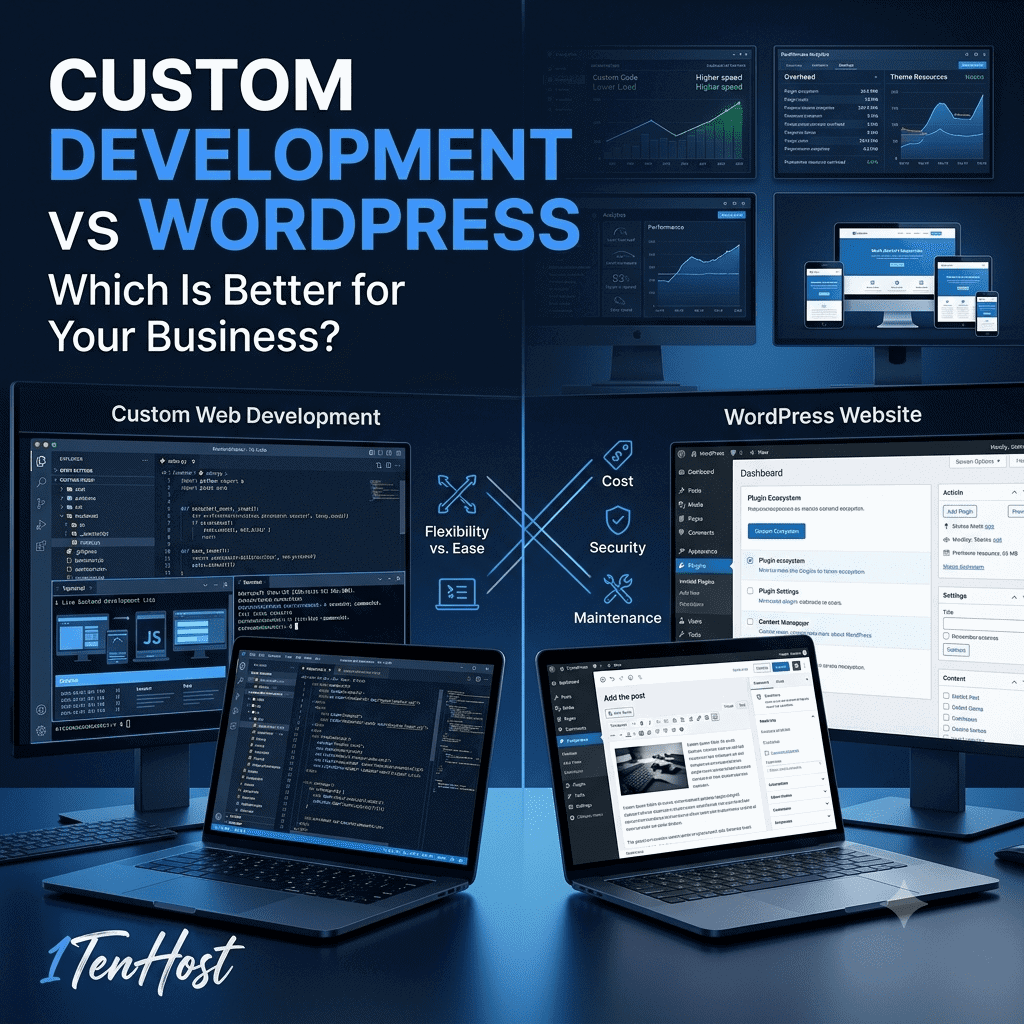
Custom web development vs WordPress, which is better for your business? Compare cost, flexibility, performance, security, and scalability before choosing.
Introduction
Choosing between custom web development and WordPress is one of the biggest decisions businesses make when building a website. And honestly, there’s no single answer that fits everyone.
For some businesses, WordPress is fast, affordable, and more than enough. For others, custom web development provides the flexibility, speed, and scalability needed for long-term growth.
The problem is that many business owners only look at the upfront cost. They don’t think about future scalability, performance limitations, maintenance, security, or how the website will support growth over the next few years.
Whether you’re running a startup in Shoreditch, an ecommerce brand in Manhattan, a software company in Karachi, or a professional service business in London, your website needs to match your goals, not just your budget.
In this guide, we’ll compare custom web development vs WordPress properly, including:
- Pros and cons
- Costs and timelines
- SEO and performance
- Security concerns
- Scalability
- Long-term ROI
- Which option suits different business types
By the end, you’ll have a much clearer idea of which direction makes the most sense for your business.
What Is Custom Web Development?
Custom web development means building a website or web application from scratch based on specific business requirements.
Instead of relying heavily on pre-made themes or plugins, developers create a tailored solution using technologies such as:
- React
- Next.js
- Laravel
- Node.js
- Vue.js
- PHP
- Python frameworks
- Custom APIs
This approach gives businesses complete control over:
- Features
- Design
- User experience
- Database structure
- Scalability
- Performance
Custom websites are often called:
- Bespoke websites
- Tailor-made web platforms
- Custom CMS solutions
- Enterprise web applications
Businesses in areas like Canary Wharf, Soho, Brooklyn, DHA Karachi, and Midtown Manhattan often choose custom development when they need advanced functionality or high scalability.
Common examples of custom web development
- SaaS platforms
- Booking systems
- Membership portals
- Ecommerce platforms
- Learning management systems
- Large corporate websites
- Marketplace platforms
- Internal business dashboards

WordPress Pros & Cons
WordPress powers a huge percentage of websites globally, and for good reason. It’s flexible, beginner-friendly, and relatively affordable.
But it also comes with limitations businesses should understand before committing long term.
WordPress Plugins & Themes
One of WordPress’s biggest advantages is its ecosystem.
You can quickly build websites using:
- Themes
- Plugins
- Page builders
- Ecommerce extensions
Popular plugin categories include:
- SEO tools
- Security plugins
- Booking systems
- Contact forms
- Ecommerce functionality
- Membership systems
This makes WordPress attractive for:
- Small businesses
- Blogs
- Startup websites
- Portfolio sites
- Local service businesses
Benefits of WordPress
- Faster development time
- Lower upfront cost
- Easier content management
- Large developer community
- Thousands of integrations
- Flexible design options
For businesses in places like Camden, Queens, Gulshan-e-Iqbal, or Brooklyn Heights, WordPress can be a practical and affordable solution for launching quickly.
WordPress Security Issues
Despite its popularity, WordPress has security concerns.
Most security risks don’t come from WordPress itself. They usually come from:
- Outdated plugins
- Poor hosting
- Cheap themes
- Weak admin security
- Unsupported extensions
Common WordPress limitations
- Plugin conflicts
- Bloated code
- Slower performance
- Frequent updates
- Higher maintenance
- Limited flexibility for advanced systems
As websites grow larger, these limitations become more noticeable.
Businesses with complex workflows often outgrow WordPress over time.
Custom Development Pros & Cons
Custom web development gives businesses far more control, but it also requires more planning, budget, and technical expertise.
Flexibility & Ownership
One of the biggest custom website benefits is complete flexibility.
You’re not restricted by:
- Plugin limitations
- Theme restrictions
- Generic layouts
- Third-party builder constraints
Everything can be designed specifically around:
- Your users
- Your workflow
- Your business goals
Advantages of custom development
- Better performance optimisation
- Cleaner code structure
- Greater scalability
- Enhanced security
- Full ownership
- Easier advanced integrations
- Better long-term flexibility
This is especially valuable for growing businesses in highly competitive markets like London, New York, and Pakistan’s tech sector.
Development Cost Reality
Now for the honest part.
Custom development usually costs more upfront.
Why?
Because developers are building features manually instead of relying on ready-made plugins.
Costs often include
- UI/UX design
- Front-end development
- Backend systems
- Database architecture
- Testing
- Security implementation
- API integrations
- Maintenance planning
For small businesses with limited budgets, this may feel expensive initially.
But for larger companies, the long-term advantages can outweigh the upfront investment.
Cost & Timeline Comparison
One of the biggest deciding factors is budget and delivery time.
WordPress development timelines
Typical WordPress projects:
- 1 to 6 weeks
Depending on:
- Number of pages
- Customisation level
- Plugin complexity
- Ecommerce setup
Custom development timelines
Custom platforms often take:
- 2 to 6 months
Sometimes longer for enterprise systems.
This is because everything is designed and developed specifically for the project.
Short vs Long Term ROI
At first glance, WordPress usually appears cheaper.
And for many businesses, it genuinely is the smarter short-term option.
But over time, businesses sometimes face:
- Plugin dependency problems
- Performance issues
- Security maintenance
- Scalability limitations
- Expensive rebuilds later
Custom development may have higher upfront costs, but it can reduce:
- Future redevelopment costs
- Technical limitations
- Performance bottlenecks
Long-term ROI depends heavily on:
- Business size
- Growth plans
- Website purpose
- Traffic expectations
Performance & Scalability
Performance is now one of the most important SEO and conversion factors.
Users expect websites to load quickly.
Google does too.
Page Speed Comparison
Custom websites usually outperform heavily customised WordPress websites in speed.
Why?
Because custom platforms often use:
- Cleaner code
- Lightweight frameworks
- Optimised architecture
- Fewer unnecessary scripts
Meanwhile, many WordPress websites become bloated due to:
- Too many plugins
- Heavy page builders
- Poor-quality themes
- Shared hosting limitations
Speed matters because it affects
- SEO rankings
- User experience
- Bounce rate
- Conversion rates
- Mobile performance
This is especially important in mobile-heavy markets like Karachi, London, and New York where users expect fast browsing experiences.
Scalability Comparison
WordPress scales reasonably well for many businesses.
However, large-scale platforms often require custom systems for:
- Complex databases
- Real-time processing
- Advanced user permissions
- Enterprise integrations
- High traffic loads
Custom development handles advanced scalability more effectively.
SEO Differences Between WordPress and Custom Websites
A common misconception is that WordPress automatically performs better for SEO.
That’s not entirely true.
SEO success depends more on:
- Site structure
- Speed
- Content quality
- Technical optimisation
- User experience
Than the platform itself.
WordPress SEO advantages
- Easy content publishing
- SEO plugins
- Beginner-friendly management
- Fast blogging setup
Custom SEO advantages
- Better performance optimisation
- Cleaner technical SEO structure
- Advanced schema flexibility
- Fully optimised architecture
- Greater Core Web Vitals control
Both can rank extremely well when built properly.
When WordPress Makes More Sense
WordPress is often the better choice for:
- Small businesses
- Blogs
- Portfolio websites
- Local businesses
- Brochure-style websites
- Businesses needing quick launch timelines
It works especially well when:
- Budget is limited
- Features are straightforward
- Content management simplicity matters
When Custom Development Makes More Sense
Custom web development is often better for:
- SaaS businesses
- Startups expecting rapid growth
- Enterprise companies
- Complex ecommerce systems
- Membership platforms
- Businesses needing unique functionality
It’s also ideal for companies wanting:
- Full control
- Strong scalability
- Advanced integrations
- Maximum performance
Making the Right Choice
Choosing between WordPress vs custom CMS development depends entirely on your business goals.
There’s no universal winner.
Decision Checklist
Ask yourself:
- How complex is the website?
- Will the business scale rapidly?
- Is performance critical?
- What’s the long-term plan?
- What’s the available budget?
- Do you need advanced functionality?
- How important is speed?
- Will multiple systems integrate together?
Your answers usually make the right option much clearer.
Common Mistakes Businesses Make
Many businesses regret their website choice because they:
- Choose based only on price
- Ignore future scalability
- Overestimate needed features
- Underestimate maintenance
- Skip SEO planning
- Use poor-quality developers
A cheap website that fails later often becomes more expensive in the long run.
Future Trends in Web Development
The web industry is changing rapidly.
Modern development trends include
- Headless CMS systems
- AI-powered experiences
- Progressive web apps
- Jamstack architecture
- Server-side rendering
- API-first development
- Mobile-first optimisation
Custom development is becoming increasingly popular for businesses wanting advanced performance and flexibility.
At the same time, WordPress continues evolving and still remains a strong option for millions of websites.
Frequently Asked Questions
Is WordPress better than custom web development?
Not always. WordPress is excellent for many businesses, while custom development works better for complex or highly scalable platforms.
Is custom web development more expensive?
Usually yes, at least initially. However, long-term costs can sometimes balance out depending on scalability and maintenance needs.
Can WordPress handle large websites?
Yes, but very large or highly customised websites may eventually face performance and flexibility limitations.
Which option is better for SEO?
Both can rank very well if properly optimised. SEO depends more on implementation quality than the platform itself.
Should startups choose WordPress or custom development?
It depends on growth plans, budget, and feature complexity. Many startups begin with WordPress, while tech-focused startups often choose custom platforms early.
Conclusion
The debate around custom web development vs WordPress isn’t really about which platform is “better”. It’s about which solution fits your business properly.
WordPress offers affordability, speed, flexibility, and easier management for many businesses. It’s often the perfect choice for startups, local companies, blogs, and service-based websites.
Custom development, on the other hand, gives businesses full control, stronger scalability, cleaner performance, and advanced flexibility for long-term growth.
The smartest decision usually comes from balancing:
- Budget
- Business goals
- Scalability needs
- Performance expectations
- Technical complexity
A website should support your growth, not limit it later.
Contact Information
Need help deciding between WordPress and custom web development for your business?
Website: 1TenHost
Email: info@1tenhost.com
WhatsApp: Chat on WhatsApp

1TenHost.com





Leave a Reply