
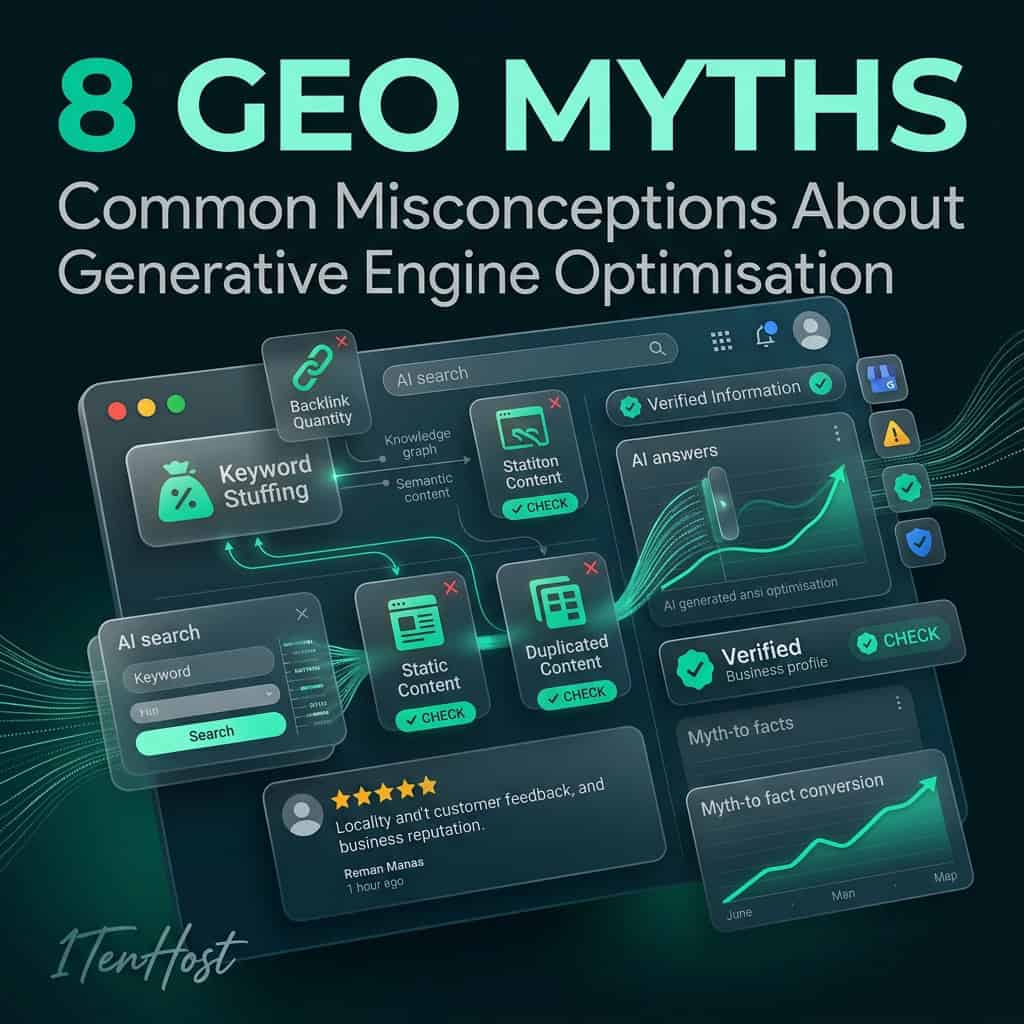
Quick Answer
GEO has not replaced SEO. Generative Engine Optimisation builds on traditional SEO by helping AI search systems understand, trust, and potentially reference your content. Strong technical SEO, useful original content, topical authority, quality backlinks, structured data, and clear answers all contribute to better visibility across AI search platforms. GEO is not simply about adding AI keywords or publishing more content. It is about becoming a reliable source that both search engines and AI systems can understand and trust.
Generative Engine Optimisation, or GEO, has quickly become one of the most discussed topics in modern search marketing. As AI platforms such as ChatGPT, Google’s AI experiences, Microsoft Copilot, Perplexity, and other answer engines become part of everyday search behaviour, businesses are asking a new question: how can they get their content recommended by AI?
That question has created plenty of confusion.
Some marketers claim GEO has completely replaced SEO. Others suggest Google rankings no longer matter, backlinks are obsolete, and adding schema markup is all a website needs to appear in AI generated answers.
These claims sound convincing, but they don’t tell the full story.
GEO isn’t a replacement for search engine optimisation. It builds on many of the same foundations that have made websites discoverable for decades. Technical accessibility, indexing, useful content, authority, expertise, reputation, and clear information still matter.
The difference is that the goal is expanding. SEO traditionally focuses on helping search engines discover, understand, and rank content. GEO adds another objective: making that content useful and trustworthy enough for AI systems to select, understand, cite, or recommend when generating an answer.
For businesses targeting customers in Karachi, London, New York, or anywhere else in the world, understanding this distinction is becoming increasingly important.
What Is GEO and Why Is Everyone Talking About It?
GEO Explained in Simple Terms
GEO stands for Generative Engine Optimisation. It refers to practices designed to improve the likelihood that a brand, website, product, organisation, or piece of content will be represented in AI generated answers.
Traditional search often gives users a list of links.
Generative search can give users a direct answer.
For example, someone searching Google for “best SEO companies in Karachi” may receive a traditional list of websites. Someone asking an AI search platform the same question may receive a written recommendation containing several businesses.
That creates a new visibility opportunity.
A company doesn’t only want to rank for a keyword. It also wants to become a source that AI systems can confidently use when constructing an answer.
GEO Doesn’t Exist Separately From SEO
This is where many businesses make their first mistake.
AI systems still need information to work with. Websites need to be accessible, discoverable, understandable, and supported by signals that indicate credibility.
That makes SEO an important foundation for GEO rather than an outdated technique.
Myth 1: GEO Has Replaced SEO
The Reality: GEO Builds on SEO
The idea that GEO has replaced SEO is one of the biggest misconceptions in the current AI search discussion.
A website that cannot be crawled properly has a fundamental visibility problem. If important pages aren’t indexed or the content is inaccessible, an AI system has less reliable information to discover and evaluate.
Technical SEO therefore remains important.
A strong foundation includes:
• Crawlable pages
• Search engine accessibility
• Proper indexing
• Clear website architecture
• Useful page titles and headings
• Fast and usable pages
• High quality content
• Internal linking
• Authority and trust signals
GEO adds another layer on top of these foundations.
Example
Imagine a London law firm creates excellent content explaining employment law.
If search engines can’t properly crawl the website, the firm’s content has a visibility problem regardless of how well written it is.
Improving the site’s technical SEO can make the information easier for search engines and other discovery systems to find.
The lesson is simple: GEO doesn’t remove the need for SEO. It makes strong SEO even more valuable.
Myth 2: You Don’t Need Google Rankings Anymore
The Reality: Search Visibility Still Matters
Another popular claim is that Google rankings no longer matter because users are moving directly to AI platforms.
That’s an oversimplification.
Search engines remain major sources of information discovery, and strong visibility can contribute to a website’s overall authority and exposure.
AI systems can use information from a wide range of sources. Search visibility, brand recognition, published expertise, references from other websites, and consistent information across the web can all contribute to how credible a business appears.
This doesn’t mean ranking number one on Google automatically guarantees an AI citation.
It doesn’t.
But abandoning search optimisation because AI exists is a poor strategy.
Example
Suppose two technology companies publish similar articles about artificial intelligence.
Company A has:
• Years of industry experience
• Strong organic visibility
• Original research
• References from respected websites
• Detailed expert content
Company B has:
• Hundreds of generic AI generated articles
• Very little organic visibility
• Few external references
• No clear expertise
Simply publishing more content doesn’t make Company B more authoritative.
The broader web presence matters.
Myth 3: Adding Schema Markup Is Enough for GEO
The Reality: Structured Data Helps, But It Isn’t the Whole Strategy
Schema markup is useful because it provides structured information about a page.
It can help search systems understand things such as:
• Articles
• Products
• Organisations
• Businesses
• Events
• Authors
• Frequently asked questions
But schema isn’t a magic switch that tells AI systems to recommend your website.
A website could have perfectly implemented structured data and still contain weak, generic, or inaccurate content.
What Matters Alongside Schema?
A stronger GEO strategy combines structured information with:
• Original research
• Demonstrable expertise
• Clear authorship
• Accurate claims
• First hand experience
• Useful examples
• Strong editorial standards
• Reliable external references
Example
Consider two articles about SEO.
The first contains FAQ schema but simply repeats information found on dozens of other websites.
The second contains useful original data, expert commentary, real examples, clear sources, and well organised explanations.
Schema can help both systems understand the pages, but the second article provides substantially more useful information for an AI system to work with.
Structured data supports content.
It doesn’t replace quality content.
Myth 4: Publishing More Content Guarantees AI Mentions
The Reality: Quality and Uniqueness Matter More Than Volume
The AI era has created another content race.
Some businesses believe they can publish hundreds or thousands of AI generated articles and eventually dominate AI search.
Quantity alone doesn’t guarantee that outcome.
AI systems need information that helps answer a question. Content that simply repeats existing material without adding anything useful may provide little reason for an AI system to select it.
A smaller library of genuinely useful resources can be more valuable than a huge collection of repetitive pages.
What Makes Content More Useful?
Strong content often includes:
• Original insights
• Specific examples
• First hand experience
• Data and evidence
• Clear explanations
• Unique perspectives
• Direct answers
• Logical structure
Example
A generic article titled “What Is Digital Marketing?” may compete with thousands of similar pages.
A detailed report analysing digital marketing trends among small businesses in Karachi could provide something more specific and useful.
The second topic has a clearer information gap and stronger contextual value.
That’s the type of difference businesses should focus on.
Myth 5: Backlinks Don’t Matter in the AI Era
The Reality: Authority Signals Still Matter
The arrival of generative AI hasn’t made every traditional authority signal irrelevant.
High quality backlinks can still demonstrate that other websites consider a source useful or credible.
Brand mentions can also contribute to a broader reputation across the web.
The important distinction is quality.
A large collection of irrelevant or manipulative links isn’t the same as earning references from respected publications, industry organisations, universities, established businesses, or authoritative websites.
Example
Imagine a cybersecurity company is mentioned by several respected technology publications and has research cited by industry experts.
That broader reputation provides stronger evidence of expertise than hundreds of low quality directory links.
For GEO, the goal shouldn’t be “get as many backlinks as possible.”
It should be to build a reputation that exists beyond your own website.
Myth 6: GEO Is Just About Using AI Keywords
The Reality: GEO Is About Authority and Answerable Information
Perhaps the most simplistic GEO strategy is to create a list of phrases that people might use when talking to AI and insert those phrases throughout a website.
That isn’t really the point.
AI systems don’t simply match a keyword and display a page. Generative systems need to interpret information and construct responses.
This makes context particularly important.
A strong GEO strategy considers:
• Search intent
• Topic relationships
• Entity relationships
• Expertise
• Context
• Supporting evidence
• User questions
• Clear answers
Example
Instead of creating ten pages targeting slightly different versions of “best SEO agency,” a business could create a comprehensive resource covering how to evaluate an SEO agency, what services matter, what questions to ask, how pricing works, what results should realistically look like, and common warning signs.
That content answers a broader information need.
It also gives AI systems more useful context when responding to related questions.
Myth 7: AI Search Will Automatically Find Your Best Content
The Reality: AI Systems Still Need Accessible and Understandable Information
Some businesses assume that if their website contains excellent content, AI platforms will automatically discover and recommend it.
That’s not guaranteed.
AI search systems need to find and interpret information from available sources. If important pages are blocked, poorly structured, difficult to crawl, outdated, or disconnected from the rest of the website, their value can be harder to recognise.
This is why technical SEO and content architecture still matter in the GEO era.
Example
Imagine a company has an excellent 3,000 word guide about ecommerce in Pakistan, but the page has poor internal linking, confusing navigation, indexing problems, and unclear headings.
Another company has a similarly useful guide but organises the information clearly, connects it to related resources, maintains strong technical SEO, and provides clear author and business information.
The second website gives search and AI systems a much clearer understanding of its content.
Great content still needs to be discoverable.
Myth 8: One GEO Strategy Will Work for Every AI Search Engine
The Reality: AI Search Systems Are Different and Constantly Evolving
Another common misconception is that there is one universal GEO formula that guarantees visibility everywhere.
There isn’t.
Google, Bing, ChatGPT, Perplexity, Gemini, and other AI driven search experiences can use different systems, data sources, ranking signals, retrieval methods, and presentation formats.
A strategy that improves visibility in one environment may not produce exactly the same results in another.
That’s why businesses should focus on fundamentals rather than chasing individual platform tricks.
Example
A website might perform strongly in traditional Google search while receiving limited visibility in an AI answer engine. Another website might have strong brand recognition and external references but need better technical optimisation.
Instead of trying to manipulate one particular AI system, build a website that consistently demonstrates:
• Expertise
• Original information
• Accuracy
• Clear structure
• Strong authority
• Useful answers
• Trustworthy references
The long term goal isn’t to trick an AI system into mentioning your brand.
It’s to become the kind of source an AI system has a good reason to mention.
SEO Gets You Discovered, GEO Helps You Get Recommended
The relationship between SEO and GEO is easier to understand when you look at the user’s journey.
SEO helps your website become discoverable through search.
GEO focuses on how your information can become part of an AI generated response.
These aren’t opposing strategies.
They overlap.
A business that wants visibility across Google, Bing, ChatGPT, Perplexity, Gemini, and other emerging search experiences should build a strong information ecosystem rather than chase a single algorithm.
That ecosystem should contain technically accessible pages, useful original content, clear entities, credible authorship, trustworthy references, strong internal connections between topics, and a reputation that extends beyond the website.
Need Help With SEO and GEO?
Understanding GEO is one thing. Preparing your website for AI search is another.
If you’re a business owner, agency, startup, or professional looking to improve your visibility across Google, Bing, and emerging AI search platforms, 1TenHost can help you build the right foundation.
From technical SEO and website optimisation to content structure, topical authority, and AI search readiness, our team can help make your website easier for search engines and AI systems to understand.
At 1TenHost, we provide professional, reliable, and customer focused digital solutions backed by industry experience. Our goal isn’t simply to help you chase rankings. We focus on building websites and digital strategies that are useful for real users and ready for the changing search landscape.
Whether you’re targeting customers in Karachi, across Pakistan, London, New York, or international markets, we can help you develop a practical SEO and GEO strategy based on your business goals.
Want to make your website ready for the AI search era? Contact 1TenHost today.
Web: 1tenhost.com
Email: info@1tenhost.com
WhatsApp: wa.me/923451151625
Call: +923453075518
Address: P.No 2, S.713 Jaffar e Tayyar Society, 75050, Karachi, Pakistan
How Businesses Should Prepare for AI Search
Start With the SEO Foundation
Before worrying about GEO, check the fundamentals.
Make sure search engines can crawl important pages and that valuable content is indexed.
Fix technical problems before producing large amounts of new content.
Build Genuine Topical Expertise
Don’t publish random articles simply because they contain popular keywords.
Build topic clusters around areas where your organisation can demonstrate knowledge.
For example, a Karachi based web development company could create connected resources covering website development, WordPress, ecommerce, website security, hosting, performance, and local business websites.
Over time, that creates a clearer topical footprint.
Create Content Worth Referencing
Ask a simple question before publishing:
Why would an AI system choose this information instead of the dozens of similar pages already available?
If the answer is unclear, the content probably needs more original value.
Add research, examples, data, expert commentary, practical experience, or a genuinely useful explanation.
Build Reputation Beyond Your Website
Your website shouldn’t be the only place where your expertise exists.
Industry mentions, interviews, research citations, partnerships, reputable backlinks, professional profiles, and independent references can all contribute to a broader digital reputation.
The Future of GEO Is Bigger Than Keywords
GEO is still an evolving field.
AI search technology continues to change, and no single optimisation technique can guarantee inclusion in an AI generated response.
That means businesses should avoid short term tricks.
The stronger approach is to build a website that search engines can access, users can trust, and AI systems can understand.
SEO remains an essential part of that process.
GEO doesn’t kill SEO.
It expands the search visibility conversation.
The businesses most likely to benefit from AI search will not necessarily be those publishing the most content or adding the most keywords. They will be the ones that consistently demonstrate expertise, provide useful information, build authority, and make their content easy for both people and machines to understand.
The principle is simple:
SEO helps you get discovered. GEO helps increase the chance of being recommended.
And in the emerging AI search landscape, businesses need both.
FAQ
What is GEO in SEO?
GEO stands for Generative Engine Optimisation. It focuses on improving the likelihood that a brand or its content will be understood, referenced, cited, or recommended by generative AI and AI search systems.
Has GEO replaced SEO?
No. GEO builds on many SEO fundamentals, including crawlability, indexing, useful content, technical accessibility, authority, and trust.
Do backlinks still matter for GEO?
High quality backlinks and independent brand mentions can remain useful authority signals. The quality and relevance of those references matter more than simply having a large number of links.
Is schema markup important for GEO?
Structured data can help systems understand information on a webpage, but schema alone isn’t enough. Original content, expertise, accuracy, and trust signals remain important.
Does publishing more content improve GEO?
Not necessarily. Large volumes of repetitive content don’t guarantee AI visibility. Original, useful, well structured information is generally a stronger approach.
Does ranking on Google help with GEO?
Strong search visibility can contribute to overall discoverability and authority, but a high Google ranking doesn’t guarantee that an AI system will mention a website.
How can a business improve its GEO strategy?
Start with technical SEO, create genuinely useful and original content, demonstrate expertise, build reputable external references, use structured data where appropriate, and organise information clearly around user questions and topics.
Is GEO only about AI keywords?
No. GEO is much broader than keyword placement. It involves content quality, topical expertise, authority, context, entities, evidence, and the ability to provide information that AI systems can confidently use.
If your business isn’t prepared for both SEO and AI search, now is the right time to start. 1TenHost can help you improve your website’s technical SEO, content structure, authority, and overall readiness for the evolving GEO landscape.
Contact 1TenHost to discuss your SEO and GEO requirements.

1TenHost.com





Leave a Reply