
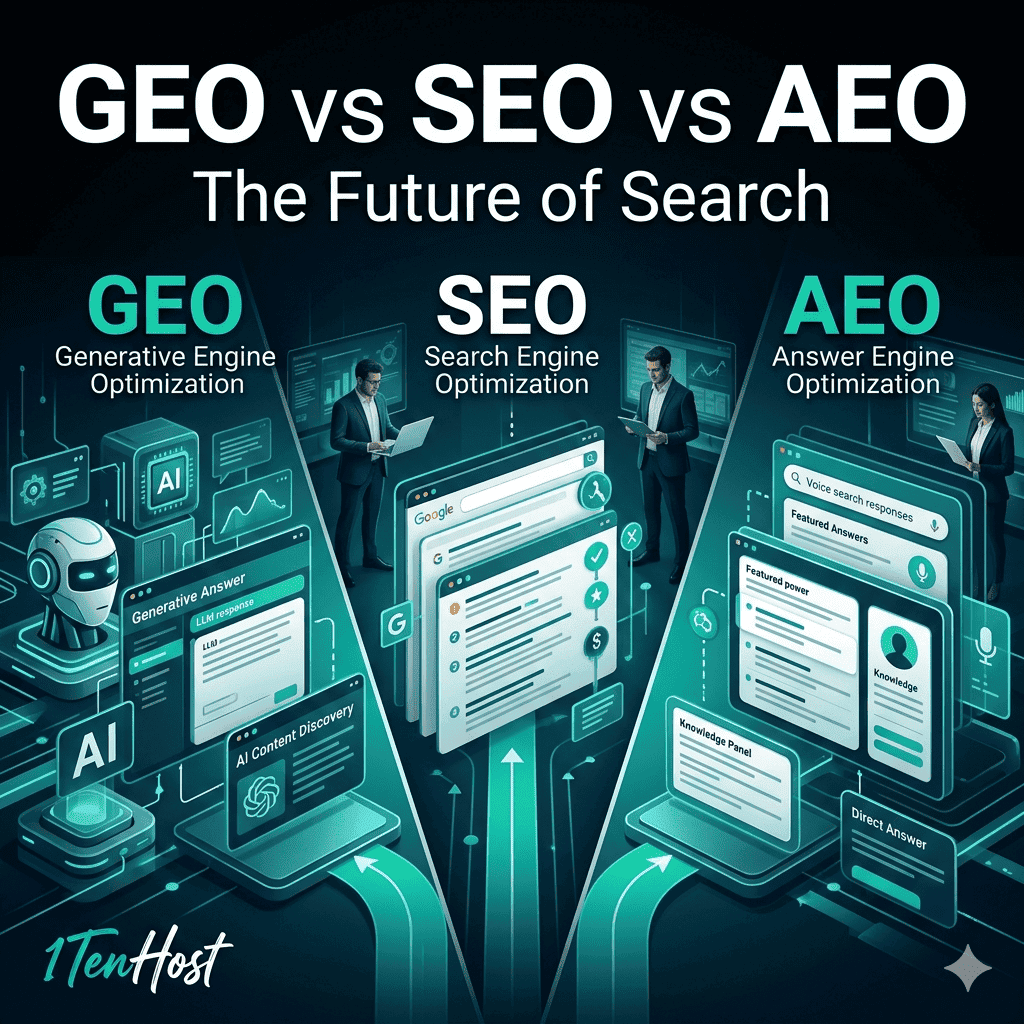
Discover the key differences between GEO, SEO, and AEO in 2026. Learn which strategy drives visibility in Google, AI search engines, and answer platforms.
Introduction
Search marketing has changed more in the last three years than it did in the previous decade.
For years, businesses focused primarily on Search Engine Optimisation (SEO) to rank on Google and attract organic traffic. Then came Answer Engine Optimisation (AEO), which helped brands appear in featured snippets, voice search results, and AI-generated answers. Now, Generative Engine Optimisation (GEO) is emerging as the next evolution, helping content get cited by AI systems such as Google AI Overviews, ChatGPT, Gemini, Claude, and Perplexity.
This shift has created confusion among marketers. Is SEO still relevant? Should businesses focus on AEO? Is GEO the future?
The truth is that modern search success requires understanding all three approaches. Each serves a different purpose within today’s search ecosystem.
Whether you’re running a business in Karachi, targeting customers across Europe, or building a global brand, understanding the GEO vs SEO vs AEO comparison is essential for future-proofing your digital marketing strategy.
In this guide, we’ll explore how search has evolved, compare each methodology, and explain how modern marketers can build a strategy that works in both traditional and AI-powered search environments.
The Search Evolution Timeline
Search behaviour has evolved significantly over the years.
The First Era: Traditional Search
In the early days, search engines primarily displayed a list of web pages based on keyword relevance.
Success depended on:
- Keywords
- Backlinks
- Technical SEO
- Website authority
Users searched, clicked, and visited websites.
The Second Era: Answer Engines
As search matured, users wanted faster answers.
Google introduced:
- Featured snippets
- Knowledge panels
- People Also Ask
- Voice search results
This led to the rise of AEO.
The goal shifted from simply ranking pages to becoming the answer.
The Third Era: Generative Search
Today, AI systems generate complete responses using information gathered from multiple sources.
Examples include:
- Google AI Overviews
- ChatGPT Search
- Perplexity AI
- Gemini
- Claude
Users increasingly receive answers without clicking multiple websites.
This evolution has created GEO.
Why This Matters
The future of search engine optimisation is no longer limited to ranking pages.
Businesses now need visibility across:
- Search engines
- Answer engines
- Generative AI platforms
SEO — Traditional Search
SEO remains the foundation of digital visibility.
Its primary goal is to help websites rank in organic search results.
SEO Core Tactics
Traditional SEO focuses on:
- Keyword research
- On-page optimisation
- Technical SEO
- Link building
- Internal linking
- User experience
- Content marketing
These strategies help search engines understand and rank webpages.
Benefits of SEO
SEO provides:
- Sustainable traffic
- Brand authority
- Long-term growth
- Lower acquisition costs
- Strong ROI over time
Unlike paid advertising, SEO continues generating value long after content is published.
Limitations of SEO
Modern search behaviour has changed.
Even highly ranked content may lose visibility when:
- Featured snippets answer questions directly
- AI Overviews summarise information
- Chatbots provide instant responses
Ranking alone is no longer enough.
AEO — Answer Engines
Answer Engine Optimisation focuses on helping content become the direct answer to user questions.
Rather than targeting clicks alone, AEO aims to secure visibility inside answer boxes and voice search results.
AEO Core Tactics
AEO strategies include:
- Question-based content
- FAQ sections
- Structured data
- Schema markup
- Featured snippet optimisation
- Voice search optimisation
The objective is clarity and directness.
Where AEO Appears
AEO helps content appear in:
- Featured snippets
- Google answer boxes
- Voice assistants
- People Also Ask results
- Knowledge panels
Why AEO Matters
Many users now search conversationally.
Examples include:
- What is GEO?
- How does AI search work?
- Which SEO strategy is best in 2026?
Answer-focused content increases visibility for these searches.
AEO Challenges
While AEO improves exposure, users may receive answers without visiting the website.
Brands must balance visibility with traffic acquisition.
GEO — Generative Search
Generative Engine Optimisation is the newest layer of search marketing.
Its purpose is helping content become a trusted source for AI-generated answers.
GEO Core Tactics
GEO focuses on:
- Topical authority
- Entity optimisation
- Semantic SEO
- EEAT signals
- Original research
- Expert content
- Source credibility
AI systems prefer content that demonstrates expertise and trustworthiness.
How GEO Works
Instead of ranking a page, AI systems evaluate:
- Content quality
- Authority signals
- Brand reputation
- Contextual relevance
- Topic depth
The goal is becoming a cited source within AI-generated responses.
GEO Platforms
Generative search visibility matters for:
- Google AI Overviews
- ChatGPT
- Perplexity
- Gemini
- Claude
- AI assistants
As AI adoption grows, GEO becomes increasingly important.
Why GEO Is Growing Fast
Users increasingly ask AI systems complex questions.
For example:
- What’s the best SEO strategy for ecommerce businesses?
- How do I improve AI search visibility?
- What’s the difference between SEO and GEO?
AI platforms generate comprehensive responses instead of displaying simple links.
This creates new opportunities for brands that optimise correctly.
Modern Marketer’s Playbook
The biggest mistake marketers make is treating SEO, AEO, and GEO as competing strategies.
In reality, they work together.
Unified Strategy Framework
A modern search strategy should include:
SEO Layer
Focus on:
- Technical optimisation
- Organic rankings
- Keyword targeting
- Content hubs
AEO Layer
Focus on:
- Direct answers
- Featured snippets
- FAQ optimisation
- Structured content
GEO Layer
Focus on:
- Topical authority
- Brand trust
- Expert insights
- AI citations
Together, these create maximum visibility.
The New Content Formula
Winning content in 2026 should:
- Answer questions clearly
- Cover topics comprehensively
- Include original expertise
- Demonstrate authority
- Use structured formatting
This approach serves both humans and AI systems.
Why EEAT Matters Everywhere
Whether you’re targeting Google, AI Overviews, or answer engines, EEAT remains critical.
Successful brands demonstrate:
- Experience
- Expertise
- Authoritativeness
- Trustworthiness
These signals influence all three optimisation models.
Which to Prioritise First
Businesses often ask which strategy deserves the most attention.
The answer depends on your stage of growth.
ROI by Strategy Stage
New Websites
Prioritise:
- SEO
- AEO
- GEO
You need strong foundations before pursuing AI visibility.
Growing Businesses
Focus on:
- SEO
- AEO
- GEO
Add answer optimisation as authority grows.
Established Brands
Prioritise:
- SEO
- GEO
- AEO
Established authority increases the likelihood of appearing in AI-generated responses.
Recommended Allocation
For most businesses:
- 60% SEO
- 20% AEO
- 20% GEO
This balanced approach maximises both current and future visibility.
The Future Outlook
SEO isn’t disappearing.
AEO isn’t replacing SEO.
GEO isn’t replacing either.
Instead, search is expanding into multiple discovery channels.
Brands that adapt early will gain a significant advantage as AI search adoption accelerates.
GEO vs SEO vs AEO Comparison Table
| Factor | SEO | AEO | GEO |
|---|---|---|---|
| Primary Goal | Rankings | Direct Answers | AI Citations |
| Main Platform | Search Engines | Answer Engines | Generative AI |
| Traffic Focus | High | Moderate | Emerging |
| Content Style | Comprehensive | Concise Answers | Topical Authority |
| Key Optimisation | Keywords & Links | Structured Answers | Entity & Trust Signals |
| Long-Term Importance | Very High | High | Very High |
| Future Growth Potential | Strong | Strong | Extremely High |
FAQs
What is the difference between GEO, SEO, and AEO?
SEO focuses on ranking webpages, AEO focuses on appearing as direct answers, and GEO focuses on becoming a trusted source for AI-generated responses.
Is SEO still important in 2026?
Yes. SEO remains the foundation of digital visibility and supports both AEO and GEO strategies.
What is GEO in digital marketing?
GEO stands for Generative Engine Optimisation, the process of improving content visibility within AI-powered search and answer platforms.
Can businesses use SEO, AEO, and GEO together?
Absolutely. The most successful brands combine all three strategies to maximise search visibility.
Which strategy offers the best ROI?
SEO generally provides the strongest long-term ROI, while GEO is becoming increasingly valuable as AI search adoption grows.
Conclusion
The modern search landscape is no longer limited to traditional rankings. Users discover information through search engines, answer engines, and AI-powered assistants simultaneously.
SEO helps you rank. AEO helps you become the answer. GEO helps AI systems trust and reference your content.
Businesses that embrace all three approaches will be better positioned to capture visibility across Google, AI Overviews, ChatGPT, Perplexity, Gemini, and future search technologies.
For marketers planning beyond 2026, the goal isn’t choosing between GEO, SEO, and AEO. It’s building a strategy that leverages the strengths of each.
Contact Information
Want to improve your SEO, AEO, GEO, and AI search visibility?
Website: 1tenhost.com
Email: info@1tenhost.com
WhatsApp: wa.me/923451151625
Call: +923453075518
Address: P.no 2, S.713 Jaffar e Tayyar Socity, 75050, Karachi, Pakistan
Map Location: https://maps.app.goo.gl/NfLfM6VkL2UxAqjbA

1TenHost.com




Leave a Reply