
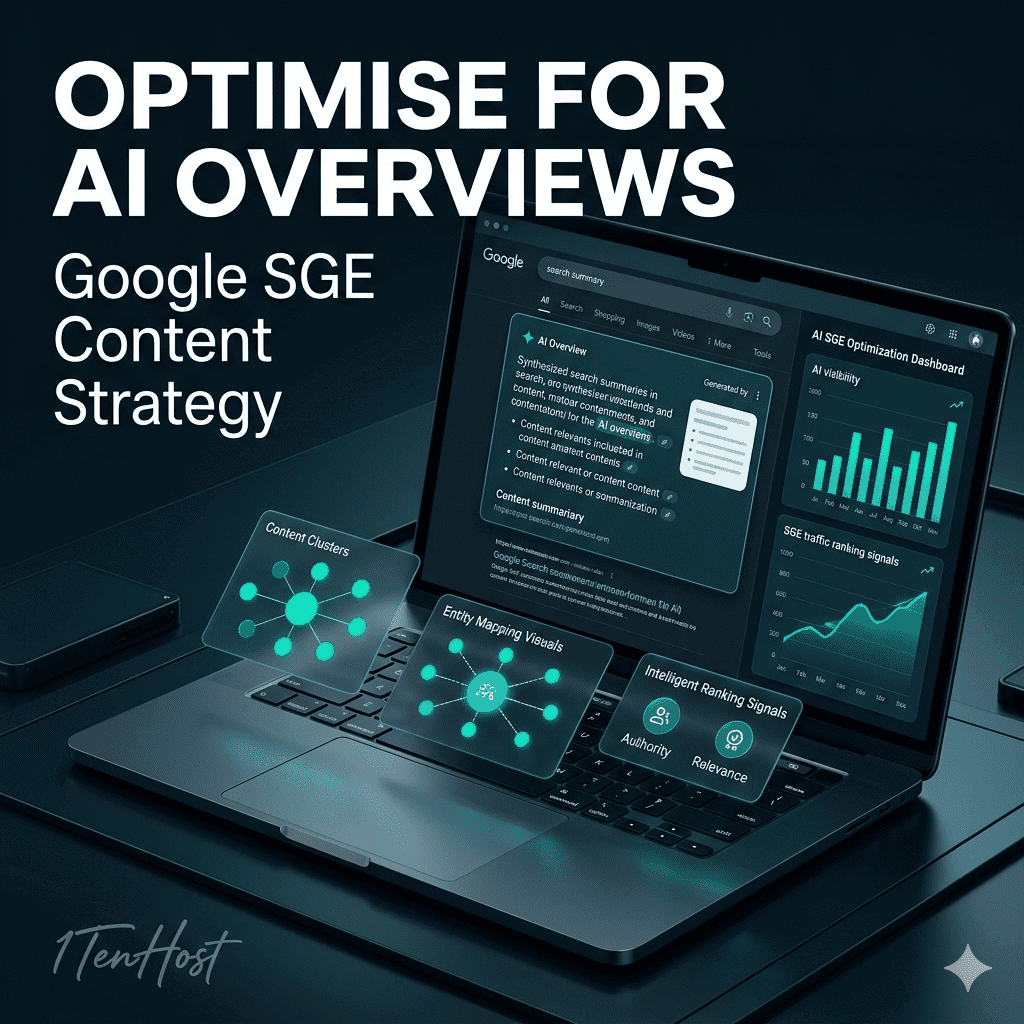
Learn how to optimise content for Google SGE and AI overviews using EEAT, structured formatting, semantic SEO, and authoritative content strategies in 2026.
Introduction
Search engines are evolving into AI-powered answer platforms. Instead of simply showing a list of blue links, Google now generates AI summaries directly within search results through Google SGE (Search Generative Experience) and AI Overviews.
For businesses, publishers, bloggers, and SEO professionals, this changes everything.
Traditional rankings still matter, but visibility inside AI-generated answers is becoming just as important. If your content appears in Google AI Overviews, users may see your brand before they even click a result.
That means content strategy in 2026 must go beyond keywords alone. Search engines now prioritise structured information, topical authority, trust signals, semantic relevance, and user-focused answers.
Whether you’re targeting global audiences, businesses in London, or competitive markets in New York, learning how to optimise content Google SGE AI overviews can significantly improve your organic visibility.
In this guide, you’ll learn how Google SGE works, how AI overviews select information, which content formats perform best, and how to create trustworthy content that AI systems actually want to reference.
Understanding Google SGE
Google SGE, short for Search Generative Experience, is Google’s AI-powered search enhancement system that creates conversational summaries directly within search results.
Instead of only showing website listings, Google generates detailed answers by combining information from multiple trusted sources.
These AI summaries often include:
- Definitions
- Step-by-step guidance
- Product recommendations
- Comparisons
- Local business information
- Expert insights
- Follow-up questions
For example, if someone searches:
- “Best SEO strategy for ecommerce stores”
- “How does technical SEO work?”
- “Ways to improve Core Web Vitals”
Google may generate a full AI overview before traditional search listings appear.
Why Google SGE Matters for SEO
AI overviews are changing click behaviour dramatically.
Users now expect:
- Faster answers
- More conversational responses
- Summarised information
- Direct solutions
This means websites must optimise for:
- AI extraction
- Semantic understanding
- Topical authority
- Structured formatting
- Trustworthiness
Businesses across areas like Canary Wharf, Shoreditch, Manhattan, Brooklyn, and SoHo are already adapting their SEO strategies to improve generative search visibility.
How AI Overviews Are Built
Google AI Overviews pull information from multiple sources to generate concise, useful summaries.
The system evaluates:
- Content quality
- Topical authority
- Relevance
- EEAT signals
- Structured formatting
- User intent alignment
Unlike traditional search snippets, AI overviews often combine insights from several websites simultaneously.
Sources SGE Pulls From
Google SGE commonly references content from:
- High-authority websites
- Expert blogs
- Industry publishers
- Government resources
- Educational sites
- Trusted news platforms
- Strong topical clusters
Pages with clear structure and semantic relevance have a better chance of being selected.
Google also favours websites that consistently publish useful, trustworthy information across related topics.
Types of AI Overview Formats
AI overviews can appear in several formats depending on the query.
Common formats include:
- Paragraph summaries
- Bullet-point lists
- Step-by-step instructions
- Product comparisons
- Shopping recommendations
- Definitions
- FAQ-style responses
For example:
A search like:
“How to optimise website speed”
may trigger:
- A concise overview
- A numbered optimisation checklist
- Supporting sources
- Follow-up questions
This is why formatting matters more than ever.
Getting Featured in AI Overviews
Ranking in traditional search results helps, but appearing inside AI overviews requires additional optimisation.
Comprehensive Topic Coverage
Thin articles rarely perform well for SGE visibility.
Google increasingly rewards comprehensive topical coverage that demonstrates deep expertise.
Instead of publishing isolated articles, build connected topic clusters.
Example structure:
Main pillar:
“Complete SEO Guide”
Supporting articles:
- Technical SEO
- Local SEO
- Ecommerce SEO
- AI search optimisation
- Schema markup
- Core Web Vitals
- Featured snippet optimisation
This creates stronger semantic relationships across your website.
Authoritative Backlinks
Backlinks still matter because they help validate trustworthiness.
Google AI systems are more likely to reference websites with strong authority signals.
High-quality backlinks can come from:
- Industry publications
- News mentions
- Expert interviews
- Research studies
- Digital PR campaigns
- Relevant partnerships
For businesses targeting London or New York markets, local authority mentions can also strengthen trust signals.
Search Intent Alignment
AI systems prioritise content that clearly satisfies user intent.
For example:
Informational searches need:
- Definitions
- Explanations
- Tutorials
Commercial searches need:
- Comparisons
- Reviews
- Buying advice
Transactional searches need:
- Clear product information
- Pricing
- CTAs
- Trust indicators
Understanding intent improves generative search relevance significantly.
Content Formatting for SGE
Structure plays a major role in AI visibility.
Messy content is harder for search engines to process effectively.
Tables, Lists & Definitions
AI systems prefer organised information.
Well-structured formatting includes:
- Bullet points
- Tables
- Short paragraphs
- FAQ sections
- Definitions
- Numbered instructions
Example Definition Format
“What is Google SGE?”
“Google SGE (Search Generative Experience) is an AI-powered search feature that generates conversational summaries directly in Google search results using information gathered from multiple web sources.”
This concise structure improves extraction potential.
Use Question-Based Headings
Question-focused headings closely match conversational searches.
Examples include:
- How does Google AI Overview work?
- Why is EEAT important for AI SEO?
- What content performs best in SGE?
This helps align your content with voice search and AI-driven queries.
Improve Readability
AI systems prefer content that is easy to understand.
Best practices include:
- Short sentences
- Clear language
- Logical flow
- Consistent formatting
- Simple explanations
Avoid unnecessary complexity.
E-E-A-T & AI Trust
EEAT has become one of the most important ranking concepts for AI search visibility.
Google wants AI overviews to reference trustworthy content.
EEAT stands for:
- Experience
- Expertise
- Authoritativeness
- Trustworthiness
Author Authority Signals
Google increasingly evaluates who created the content.
Strong authority signals include:
- Expert author bios
- Industry experience
- Real-world examples
- Published credentials
- Accurate information
- Trustworthy citations
For example, a detailed SEO guide written by an experienced SEO consultant is more likely to be trusted than anonymous low-quality content.
Build Brand Trust
AI systems also evaluate overall website reputation.
Helpful trust indicators include:
- HTTPS security
- Clear contact information
- Transparent policies
- Positive brand mentions
- Consistent publishing quality
This is especially important in competitive markets like London, Westminster, Manhattan, and Brooklyn.
Originality Matters
Generic AI-generated content without real value often struggles to rank.
Google increasingly rewards:
- Unique insights
- Original research
- Personal experience
- Data-driven content
- Expert analysis
Adding genuine expertise helps differentiate your content from mass-produced pages.
Monitoring SGE Visibility
Tracking AI overview performance is becoming a major part of SEO reporting.
SGE Tracking Tools
Several SEO tools now monitor generative search visibility.
Useful platforms include:
- Semrush
- Ahrefs
- Sistrix
- Surfer SEO
- seoClarity
- Google Search Console
These tools help identify:
- AI overview appearances
- Featured snippet wins
- Visibility trends
- Query opportunities
Key Metrics to Monitor
Important metrics include:
- Organic impressions
- Click-through rates
- AI overview mentions
- Featured snippet ownership
- Branded search growth
- Engagement metrics
SEO success is increasingly about visibility across multiple search surfaces, not just rankings alone.
Watch Competitor Trends
Monitor competitors appearing inside AI overviews.
Analyse:
- Their formatting
- Topic depth
- Content structure
- Internal linking
- EEAT signals
This can reveal optimisation opportunities quickly.
Common Mistakes to Avoid
Many websites struggle with AI visibility because of avoidable SEO issues.
Common mistakes include:
- Thin content
- Weak topical authority
- Poor formatting
- Lack of semantic keywords
- Over-optimised anchor text
- Missing structured data
- Generic AI-written content
- Weak internal linking
- Ignoring search intent
Modern SEO requires depth, clarity, and trust.
FAQs
What is Google SGE?
Google SGE (Search Generative Experience) is Google’s AI-powered search feature that generates conversational summaries directly within search results.
How do I optimise content for AI overviews?
Use structured formatting, strong EEAT signals, semantic SEO, topical authority, concise answers, and user-focused content.
Does Google AI Overview replace traditional SEO?
No. Traditional SEO still matters, but websites must now optimise for both rankings and AI-generated search visibility.
What type of content performs best in SGE?
Comprehensive, trustworthy, well-structured content with clear formatting and strong topical relevance tends to perform best.
Are backlinks still important for AI SEO?
Yes. Authoritative backlinks remain important because they strengthen trust and credibility signals.
Conclusion
Google SGE and AI Overviews are transforming the future of search. Websites can no longer rely purely on keyword rankings or basic optimisation tactics.
Success in 2026 depends on creating trustworthy, comprehensive, and well-structured content that AI systems can easily understand and reference.
Businesses targeting audiences in London, New York, Europe, or globally should focus on semantic SEO, topical authority, strong EEAT signals, and user-first content experiences.
The websites that consistently provide accurate, helpful, and genuinely valuable information will become the sources AI search engines trust most.
And in the AI search era, trust is quickly becoming the ultimate ranking factor.
Contact Information
Need help improving your AI search visibility, Google SGE optimisation, or SEO strategy?
Website: 1tenhost.com
Email: info@1tenhost.com
WhatsApp: wa.me/923451151625
Call: +923453075518
Address: P.no 2, S.713 Jaffar e Tayyar Socity, 75050, Karachi, Pakistan
Map Location: https://maps.app.goo.gl/NfLfM6VkL2UxAqjbA

1TenHost.com




Leave a Reply